Get started with Price Convergence.
If you're issuing a tokenized stock and want to eliminate stale prices and
manual pool maintenance, talk to
the Arrakis team.
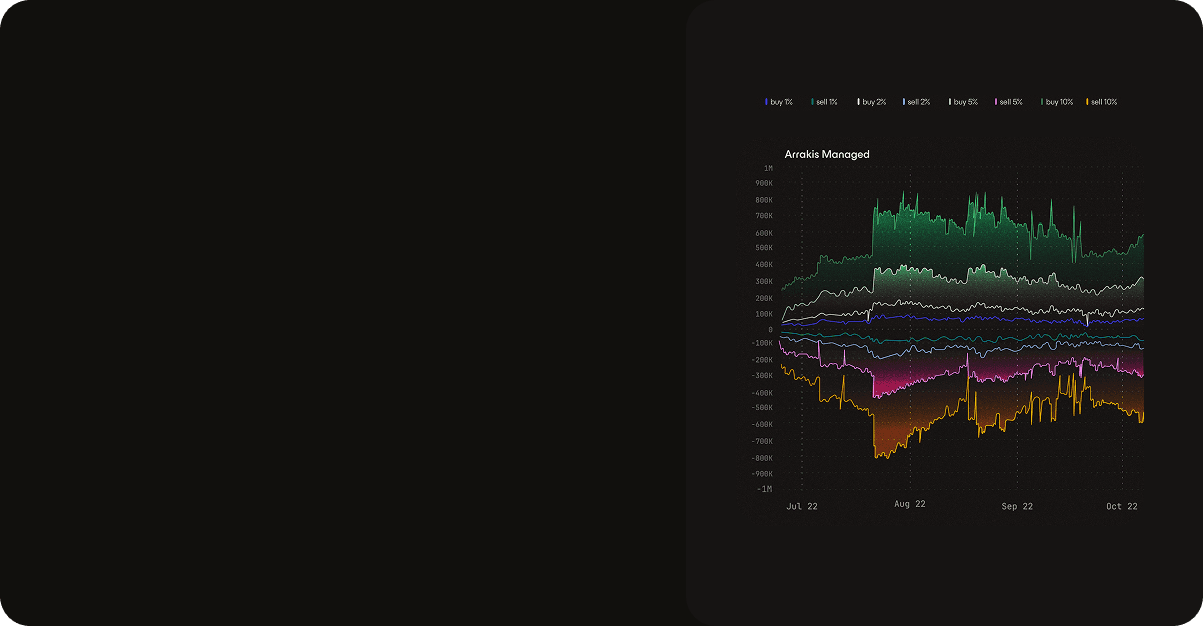
Built for Developers
Price Convergence is enabled by programmable hooks on Uniswap V4, which allow pool behavior to be modified at the protocol level.
01 Read Reference Price
During rebalancing, the Arrakis Pro Hook reads the real-world stock price from external price feeds.
02 Update Pool Price
The Hook updates the tokenized equity pool price to match the real-world stock price.
01 Read Reference Price
Arrakis repositions concentrated liquidity around the updated price, ensuring the highest capital efficiency.
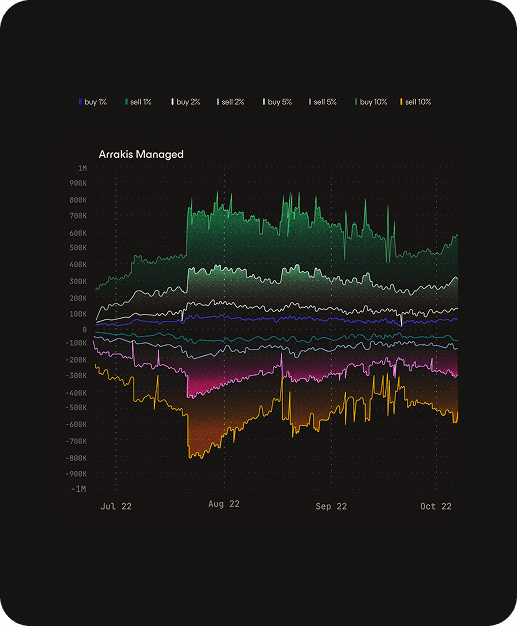
Built for Developers
Price Convergence is enabled by programmable hooks on Uniswap V4, which allow pool behavior to be modified at the protocol level.
01 Read Reference Price
During rebalancing, the Arrakis Pro Hook reads the real-world stock price from external price feeds.
02 Update Pool Price
The Hook updates the tokenized equity pool price to match the real-world stock price.
01 Read Reference Price
Arrakis repositions concentrated liquidity around the updated price, ensuring the highest capital efficiency.
Why Tokenized Stock Pools Go Stale
Why Tokenized Stock
Pools Go Stale
AMM pools only update when trades happen. For tokenized stocks, third-party arbitrage is rare due to redemption complexity and thin liquidity. When pool prices drift, issuers end up correcting their own pools manually, at significant cost.
Price Convergence is the first product that programmatically updates pool prices to match the correct asset price during rebalances.
AMM pools only update when trades happen. For tokenized stocks, third-party arbitrage is rare due to redemption complexity and thin liquidity. When pool prices drift, issuers end up correcting their own pools manually, at significant cost.
Price Convergence is the first product that programmatically updates pool prices to match the correct asset price during rebalances.
Key Feautures
Key Feautures

MEV Protection
Price update happens atomically within the rebalance transaction, leaving zero room for arbitrage exploits or MEV extraction.

Oracle-agnostic
Supports any external price feed, including Chainlink,
Pyth, and exchange rate contracts.
Live on Uniswap V4
Available on Ethereum,
Arbitrum, Base, Optimism,
BNB Chain, and Unichain.
Non-custodial
Issuers retain full control
of their assets at all times. Withdraw without restriction.
What This Means for Issuers
Price Convergence eliminates the operational and financial burden of keeping tokenized equity pools accurate.
No More Manual Pool Management
Price Convergence makes accurate pricing a native property of the pool.
No monitoring, no manual trades, no operational complexity to keep prices aligned.
No Value Leakage
Without Price Convergence, issuers absorb the cost of trading against stale prices to correct their own pools. That cost compounds over time. Price Convergence removes it entirely.
Tighter Spreads, More Volume
Accurate pool pricing and concentrated liquidity around the correct price reduce slippage and attract more volume.
Why Arrakis
Performance-fee-only model
No upfront costs, no retainers. Fees are charged only on value delivered.
Full transparency
Real-time analytics dashboard and every position is verifiable onchain.
Full transparency
Dedicated liquidity strategists work directly with your team to design, deploy, and optimize your strategy.
Volume facilitated
$1.8B+
Vaults deployed
500+
Chains supported
50+
Token Issuers
100+
Why Arrakis
Volume facilitated
$1.8B+
Vaults deployed
500+
Chains supported
50+
Token Issuers
100+
Performance-fee-only model
No upfront costs, no retainers. Fees are charged only on value delivered.
Full transparency
Real-time analytics dashboard and every position is verifiable onchain.
White-glove service
Dedicated liquidity strategists work directly with your team to design,
deploy, and optimize your strategy.
Accurate Onchain Pricing
for Tokenized Stocks
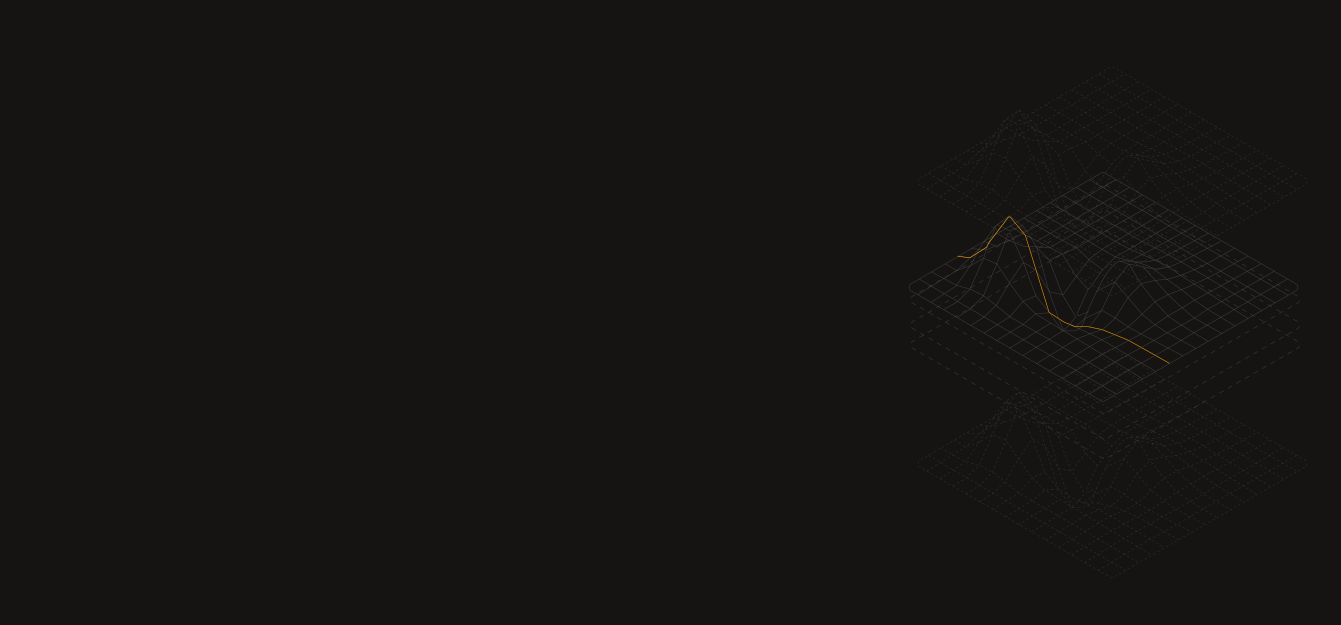
Arrakis Price Convergence automatically updates AMM pool prices to match real-world equity prices, eliminating stale pricing and manual pool management.
View Documentation

Accurate Onchain Pricing for
Tokenized Stocks
Arrakis Price Convergence automatically updates AMM pool prices to match real-world equity prices, eliminating stale pricing and manual pool management.
Documentation
Learn more
© 2025 Arrakis Finance
Learn more
© 2025 Arrakis Finance
Proven in Production With Industry Leaders
Tokenized gold backed by MKS PAMP-refined bullion.
"DGLD can be redeemed for physical gold at any time, so its onchain price must mirror the global gold spot market. Price Convergence ensures our pools align automatically, reducing friction for traders, eliminating operational risk from manual adjustments, and dramatically improving liquidity management."
— Antoine Sarraute,
Head of Technology, DGLD
FAQ
FAQ
FAQ
How does Price Convergence differ from regular AMM liquidity?
Standard AMMs rely on arbitrageurs to correct price deviations. For tokenized equities, that arbitrage often does not happen because it’s impractical due to redemption complexity and timing mismatches. Price Convergence removes this dependency by updating pool prices programmatically during rebalances, using oracle feeds.
Can we manage our own liquidity instead?
Self-managed concentrated liquidity works in stable conditions but breaks during volatility. Morpho self-managed their Uniswap V3 pool and saw price impact spikes during volatile periods. After migrating to Arrakis Pro, sell-side price impact dropped ~60% with 27% less TVL. Self-management also creates ongoing operational overhead: gas costs, monitoring, manual rebalancing, and MEV leakage. Arrakis reduces operational cost to near zero.
Will Arrakis sell our tokens into the market?
Arrakis uses a maker-only primitive. It places limit orders above the current market price and never executes market sells. Every rebalance transaction is visible on the Arrakis Reports dashboard and verifiable onchain.
Will providing liquidity create impermanent loss?
Impermanent loss is the cost of providing liquidity in any AMM. For externally-priced assets, Price Convergence reduces this risk by updating pool prices atomically to match reference values. The pool moves directly to the correct price without leaving a gap for arbitrageurs to exploit. Dynamic fees further protect against LVR (Loss Versus Rebalancing) by increasing fees during volatile periods. The relevant comparison is IL cost versus the cost of alternatives: manual pool corrections, emissions programs, or CEX market maker retainers.
Our CEX market maker says they can handle DEX liquidity too.
CEX market makers bundling DEX management typically deploy passive full-range positions, not actively managed concentrated liquidity. Their economics come from the CEX side (loan and option fees, spread capture, inventory gains) — DEX management is a checkbox item. In a documented case, 92% of a CEX market maker's profit came from inventory trading, not spread capture. Arrakis is purpose-built for concentrated liquidity: 3-4x more depth per dollar than full-range, dynamic fees, MEV protection, and Price Convergence, none of which a passive deployment provides.
We're a regulated entity. Can we interact with DeFi directly?
Arrakis has a proven structure for regulated issuers. Tokens are provided as a non-interest-bearing loan to Arrakis's Swiss GmbH, which deploys them into onchain pools via a separate multisig. The entity can track the multisig onchain and verify all funds go exclusively into the Arrakis vault. SLA agreements are available for institutional compliance. This structure has been used with regulated entities including Bitpanda.
What happens outside of market hours?
The pool price reflects the last known equity price from the oracle feed. During periods when the underlying market is closed, the pool maintains the closing price. When the market reopens and the oracle updates, the next rebalance adjusts the pool price accordingly.
Which price feeds are supported?
Price Convergence is oracle-agnostic. It supports Chainlink, Pyth, custom oracle feeds, and exchange rate contracts. The specific feed is configured per deployment based on the asset type and issuer requirements.
Does our token need KYC for minting or redeeming?
The Arrakis vault address can be whitelisted on your mint/redeem contract as a one-time permissioning step. The vault then mints and redeems atomically during rebalances without requiring per-transaction KYC. This model is already in production with yield-bearing assets that have permissioned access controls.
Is this custodial?
No. All Arrakis Pro vaults are non-custodial. Issuers retain full ownership of their assets at all times and can withdraw without restriction.
What chains are supported?
Uniswap V4 deployments on Ethereum, Arbitrum, Base, Optimism, BNB Chain, and Unichain. Additional chains are added as Uniswap V4 expands.
What does it cost?
Arrakis Pro operates on a performance-fee-only model. There are no upfront costs or retainers. Fees are charged only on value delivered.
How long does deployment take?
Vault setup takes 1-2 days from green light. The preparation time is in strategy design and oracle configuration, not deployment. For assets with existing onchain price feeds (Chainlink, Pyth), the process is faster. For assets requiring custom oracle integration, timeline depends on feed availability.
How long does deployment take?
Vault setup takes 1-2 days from green light. The preparation time is in strategy design and oracle configuration, not deployment. For assets with existing onchain price feeds (Chainlink, Pyth), the process is faster. For assets requiring custom oracle integration, timeline depends on feed availability.
Proven in Production With Industry Leaders
Tokenized gold backed by MKS PAMP-refined bullion.
"DGLD can be redeemed for physical gold at any time, so its onchain price must mirror the global gold spot market. Price Convergence ensures our pools align automatically, reducing friction for traders, eliminating operational risk from manual adjustments, and dramatically improving liquidity management."
— Antoine Sarraute,
Head of Technology, DGLD
FAQ
FAQ
FAQ
How does Price Convergence differ from regular AMM liquidity?
Standard AMMs rely on arbitrageurs to correct price deviations. For tokenized equities, that arbitrage often does not happen because it’s impractical due to redemption complexity and timing mismatches. Price Convergence removes this dependency by updating pool prices programmatically during rebalances, using oracle feeds.
Can we manage our own liquidity instead?
Self-managed concentrated liquidity works in stable conditions but breaks during volatility. Morpho self-managed their Uniswap V3 pool and saw price impact spikes during volatile periods. After migrating to Arrakis Pro, sell-side price impact dropped ~60% with 27% less TVL. Self-management also creates ongoing operational overhead: gas costs, monitoring, manual rebalancing, and MEV leakage. Arrakis reduces operational cost to near zero.
Will Arrakis sell our tokens into the market?
Arrakis uses a maker-only primitive. It places limit orders above the current market price and never executes market sells. Every rebalance transaction is visible on the Arrakis Reports dashboard and verifiable onchain.
Will providing liquidity create impermanent loss?
Impermanent loss is the cost of providing liquidity in any AMM. For externally-priced assets, Price Convergence reduces this risk by updating pool prices atomically to match reference values. The pool moves directly to the correct price without leaving a gap for arbitrageurs to exploit. Dynamic fees further protect against LVR (Loss Versus Rebalancing) by increasing fees during volatile periods. The relevant comparison is IL cost versus the cost of alternatives: manual pool corrections, emissions programs, or CEX market maker retainers.
Our CEX market maker says they can handle DEX liquidity too.
CEX market makers bundling DEX management typically deploy passive full-range positions, not actively managed concentrated liquidity. Their economics come from the CEX side (loan and option fees, spread capture, inventory gains) — DEX management is a checkbox item. In a documented case, 92% of a CEX market maker's profit came from inventory trading, not spread capture. Arrakis is purpose-built for concentrated liquidity: 3-4x more depth per dollar than full-range, dynamic fees, MEV protection, and Price Convergence, none of which a passive deployment provides.
We're a regulated entity. Can we interact with DeFi directly?
Arrakis has a proven structure for regulated issuers. Tokens are provided as a non-interest-bearing loan to Arrakis's Swiss GmbH, which deploys them into onchain pools via a separate multisig. The entity can track the multisig onchain and verify all funds go exclusively into the Arrakis vault. SLA agreements are available for institutional compliance. This structure has been used with regulated entities including Bitpanda.
What happens outside of market hours?
The pool price reflects the last known equity price from the oracle feed. During periods when the underlying market is closed, the pool maintains the closing price. When the market reopens and the oracle updates, the next rebalance adjusts the pool price accordingly.
Which price feeds are supported?
Price Convergence is oracle-agnostic. It supports Chainlink, Pyth, custom oracle feeds, and exchange rate contracts. The specific feed is configured per deployment based on the asset type and issuer requirements.
Does our token need KYC for minting or redeeming?
The Arrakis vault address can be whitelisted on your mint/redeem contract as a one-time permissioning step. The vault then mints and redeems atomically during rebalances without requiring per-transaction KYC. This model is already in production with yield-bearing assets that have permissioned access controls.
Is this custodial?
No. All Arrakis Pro vaults are non-custodial. Issuers retain full ownership of their assets at all times and can withdraw without restriction.
What chains are supported?
Uniswap V4 deployments on Ethereum, Arbitrum, Base, Optimism, BNB Chain, and Unichain. Additional chains are added as Uniswap V4 expands.
What does it cost?
Arrakis Pro operates on a performance-fee-only model. There are no upfront costs or retainers. Fees are charged only on value delivered.
How long does deployment take?
Vault setup takes 1-2 days from green light. The preparation time is in strategy design and oracle configuration, not deployment. For assets with existing onchain price feeds (Chainlink, Pyth), the process is faster. For assets requiring custom oracle integration, timeline depends on feed availability.
How long does deployment take?
Vault setup takes 1-2 days from green light. The preparation time is in strategy design and oracle configuration, not deployment. For assets with existing onchain price feeds (Chainlink, Pyth), the process is faster. For assets requiring custom oracle integration, timeline depends on feed availability.
FAQ
How does Price Convergence differ from regular AMM liquidity?
Standard AMMs rely on arbitrageurs to correct price deviations. For tokenized equities, that arbitrage often does not happen because it’s impractical due to redemption complexity and timing mismatches. Price Convergence removes this dependency by updating pool prices programmatically during rebalances, using oracle feeds.
Can we manage our own liquidity instead?
Self-managed concentrated liquidity works in stable conditions but breaks during volatility. Morpho self-managed their Uniswap V3 pool and saw price impact spikes during volatile periods. After migrating to Arrakis Pro, sell-side price impact dropped ~60% with 27% less TVL. Self-management also creates ongoing operational overhead: gas costs, monitoring, manual rebalancing, and MEV leakage. Arrakis reduces operational cost to near zero.
Will Arrakis sell our tokens into the market?
Arrakis uses a maker-only primitive. It places limit orders above the current market price and never executes market sells. Every rebalance transaction is visible on the Arrakis Reports dashboard and verifiable onchain.
Will providing liquidity create impermanent loss?
Impermanent loss is the cost of providing liquidity in any AMM. For externally-priced assets, Price Convergence reduces this risk by updating pool prices atomically to match reference values. The pool moves directly to the correct price without leaving a gap for arbitrageurs to exploit. Dynamic fees further protect against LVR (Loss Versus Rebalancing) by increasing fees during volatile periods. The relevant comparison is IL cost versus the cost of alternatives: manual pool corrections, emissions programs, or CEX market maker retainers.
Our CEX market maker says they can handle DEX liquidity too.
CEX market makers bundling DEX management typically deploy passive full-range positions, not actively managed concentrated liquidity. Their economics come from the CEX side (loan and option fees, spread capture, inventory gains) — DEX management is a checkbox item. In a documented case, 92% of a CEX market maker's profit came from inventory trading, not spread capture. Arrakis is purpose-built for concentrated liquidity: 3-4x more depth per dollar than full-range, dynamic fees, MEV protection, and Price Convergence, none of which a passive deployment provides.
We're a regulated entity. Can we interact with DeFi directly?
Arrakis has a proven structure for regulated issuers. Tokens are provided as a non-interest-bearing loan to Arrakis's Swiss GmbH, which deploys them into onchain pools via a separate multisig. The entity can track the multisig onchain and verify all funds go exclusively into the Arrakis vault. SLA agreements are available for institutional compliance. This structure has been used with regulated entities including Bitpanda.
What happens outside of market hours?
The pool price reflects the last known equity price from the oracle feed. During periods when the underlying market is closed, the pool maintains the closing price. When the market reopens and the oracle updates, the next rebalance adjusts the pool price accordingly.
Which price feeds are supported?
Price Convergence is oracle-agnostic. It supports Chainlink, Pyth, custom oracle feeds, and exchange rate contracts. The specific feed is configured per deployment based on the asset type and issuer requirements.
Does our token need KYC for minting or redeeming?
The Arrakis vault address can be whitelisted on your mint/redeem contract as a one-time permissioning step. The vault then mints and redeems atomically during rebalances without requiring per-transaction KYC. This model is already in production with yield-bearing assets that have permissioned access controls.
Is this custodial?
No. All Arrakis Pro vaults are non-custodial. Issuers retain full ownership of their assets at all times and can withdraw without restriction.
What chains are supported?
Uniswap V4 deployments on Ethereum, Arbitrum, Base, Optimism, BNB Chain, and Unichain. Additional chains are added as Uniswap V4 expands.
What does it cost?
Arrakis Pro operates on a performance-fee-only model. There are no upfront costs or retainers. Fees are charged only on value delivered.
How long does deployment take?
Vault setup takes 1-2 days from green light. The preparation time is in strategy design and oracle configuration, not deployment. For assets with existing onchain price feeds (Chainlink, Pyth), the process is faster. For assets requiring custom oracle integration, timeline depends on feed availability.
How long does deployment take?
Vault setup takes 1-2 days from green light. The preparation time is in strategy design and oracle configuration, not deployment. For assets with existing onchain price feeds (Chainlink, Pyth), the process is faster. For assets requiring custom oracle integration, timeline depends on feed availability.
Get started with Price Convergence.