Arrakis Pro

TL;DR
RWAs and other externally-priced assets have values determined outside of DeFi: NAV calculations, commodity spot prices, forex rates, accruing yield. But AMM pools only update when someone trades, creating persistent drift between the pool price and the asset's true value.
For most of these assets, third-party arbitrage is unreliable or nonexistent. Redemption queues are long, liquidity is thin, and the risk-adjusted return isn't there. Issuers end up manually arbitraging their own pools to maintain accuracy. This is operationally costly and unsustainable.
Arrakis Pro's Price Convergence feature, built on Uniswap V4, solves this by programmatically updating pool prices to match reference values during rebalances. No arbitrage or manual intervention required.
For tokenized commodities: Pool prices track spot prices directly, even as global markets move continuously.
For NAV-based credit products: Pool prices reflect current NAV without waiting for external arbitrage that may never come.
For FX stablecoins: Pool prices stay aligned with forex rates, even during low-volume periods when drift would otherwise accumulate.
For yield-bearing assets: Pool prices track accruing yield automatically, staying aligned with the asset's exchange rate without constant repositioning.
Centrifuge (deJAAA) and DGLD are the first to deploy with Price Convergence enabled.
The Problem: When Arbitrage Doesn't Show Up
Most liquidity pools rely on arbitrageurs to keep prices accurate. For crypto tokens where price discovery happens onchain or on CEXs, this works. Arbitrageurs are incentivized to correct discrepancies and the market stays efficient.
Externally-priced assets are different. Their values are set outside of DeFi: a gold spot price on global commodity markets, a NAV derived from loan performance, a forex rate moving on traditional FX markets. The AMM has no awareness of these values and only updates through trades.
Arbitrageurs should step in when pool prices drift. For these assets, they often don't.
Redemption processes can be slow, illiquid, and operationally complex. For smaller assets or during low-volume periods, the risk-adjusted return simply isn't there. Arbitrageurs stay away, and the pool price drifts further from reality.
This is one of the core reasons AMMs have struggled to support RWAs and other externally-priced assets at scale.
The Hidden Cost: Issuer-Driven Arbitrage
When external arbitrage fails to materialize, issuers face a choice: let the pool price drift, or correct it themselves.
Many issuers end up running internal processes to monitor pool prices and manually trade them back toward the reference value when drift accumulates. This introduces operational overhead, governance complexity, and value leakage that compounds over time.
What remains is a fragile equilibrium: the issuer continuously maintains their own pool, or the market trades against stale pricing as liquidity drifts out of range. Neither is sustainable.
How Price Convergence Works
The Arrakis Pro Hook on Uniswap V4 replaces this manual maintenance loop with protocol-level logic.
During rebalance operations, the Hook reads a reference price from an external source and updates the pool's internal price state to match. The source depends on the asset:
For tokenized commodities like DGLD, the Hook reads from a price feed reflecting the global gold spot market.
For NAV-based credit products like Centrifuge's deJAAA, the Hook reads from an onchain NAV feed.
For FX stablecoins, the Hook reads from forex price feeds to track real-world exchange rates.
For yield-bearing assets, the Hook reads from the asset's exchange rate contract (e.g., ERC-4626 vaults).
The update happens atomically within the rebalance transaction. There is no window for arbitrageurs to exploit, and no need for them to show up in the first place. The pool moves directly to the correct price.
This is not possible on previous AMM designs. Price Convergence is enabled by programmable hooks on Uniswap V4, which allow pool behavior to be modified at the protocol level.
Instead of paying arbitrageurs (or paying internal ops to act like arbitrageurs), issuers get accurate pricing as a native property of the pool.
Who Benefits
Tokenized Commodities
DGLD is tokenized gold issued by Gold Token SA, the tokenization arm of MKS PAMP, one of the world's largest precious metals refiners. Each DGLD token represents allocated ownership of PAMP-refined gold bars held in Swiss vaults, and is physically redeemable down to one gram.
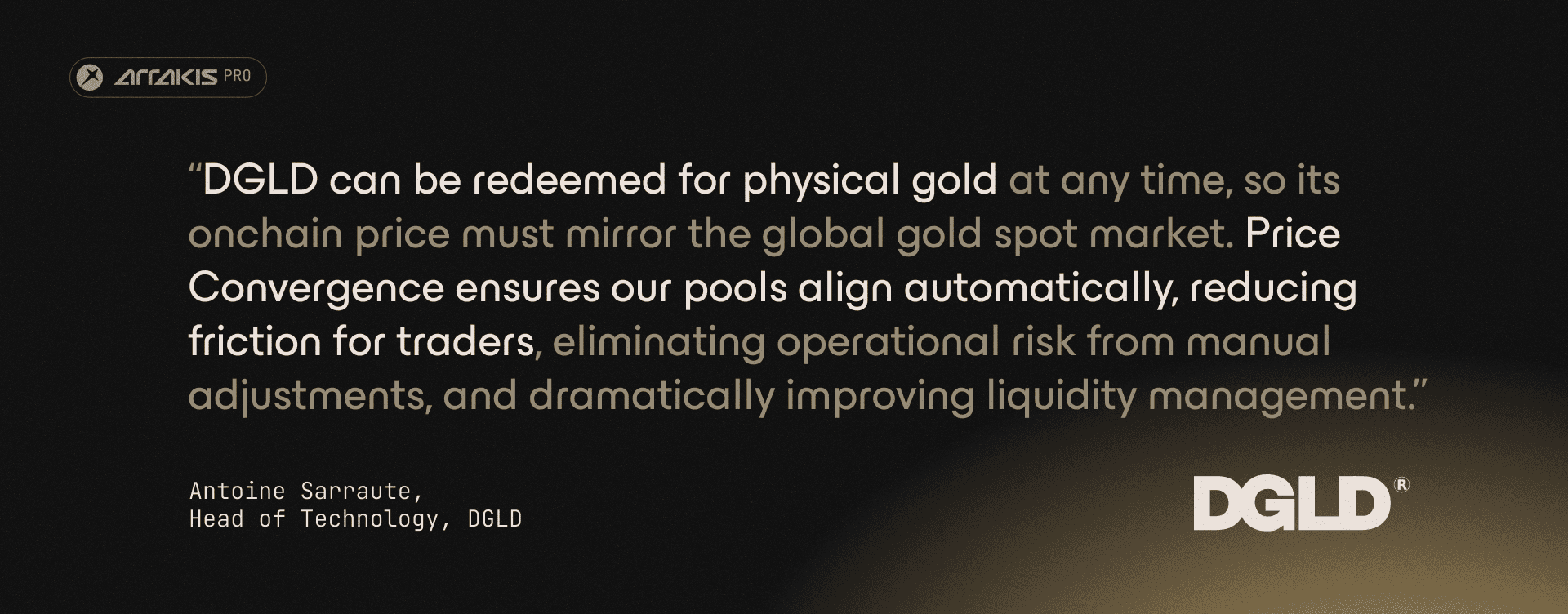
Gold prices move continuously on global markets. Without Price Convergence, DGLD's onchain pools would require constant arbitrage or manual correction to stay accurate. With Price Convergence, pool prices track spot gold directly.
NAV-Based Credit Products
Centrifuge's deJAAA represents tokenized exposure to short-duration U.S. Treasury bills. The asset's NAV updates based on underlying performance, but onchain pools have historically struggled to reflect this accurately.
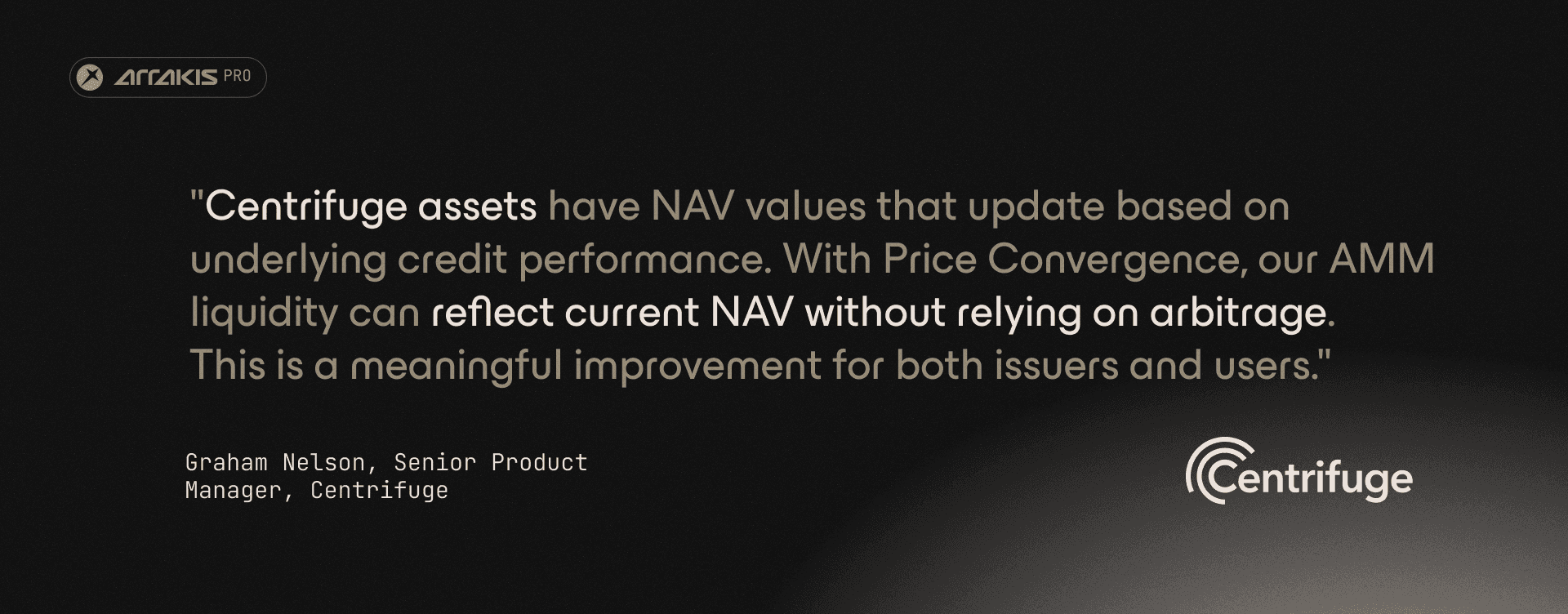
Third-party arbitrage for deJAAA is impractical due to redemption friction. Before Price Convergence, maintaining accurate pool prices required manual intervention from the Centrifuge team.
Tokenized Stocks
Tokenized stocks from issuers like Backed Finance, Superstate, and Centrifuge bring exposure to equities like Tesla, Apple, and the S&P 500 onchain. But stock prices move during market hours while AMM pools sit static.
When traditional markets are open, pool prices diverge from the underlying equity. After-hours gaps, earnings announcements, and corporate actions widen the drift. Redemption complexity makes third-party arbitrage impractical.
Price Convergence keeps tokenized equity pools aligned with real-world stock prices by reading from equity price feeds during rebalances.
FX Stablecoins
Non-USD stablecoins like EURS, agEUR, or CADC should track forex rates. But onchain pools have no native awareness of FX markets.
The EUR/USD rate moves 24/7 on global forex markets. An EURS/USDC pool only moves when someone trades. During low-volume periods, drift accumulates. The pool price diverges from the real exchange rate, and without reliable arbitrage, it stays that way.
Price Convergence keeps FX stablecoin pairs aligned with real-world rates by reading from forex price feeds during each rebalance. For stablecoin issuers targeting non-USD markets, this removes a persistent source of friction.
What This Unlocks
For issuers: No more manual pool maintenance. Accurate pricing becomes a native property of the pool, not an operational burden.
For traders: Better execution. The pool price reflects the asset's true value, not a stale approximation waiting for arbitrage that may never come.
For the broader ecosystem: Infrastructure-level support for externally-priced assets. Most AMM-based solutions still rely on arbitrage to correct prices. Price Convergence removes that dependency entirely, addressing a structural limitation that has kept RWAs, FX stablecoins, yield-bearing tokens, and other oracle-priced assets from achieving efficient AMM-based liquidity.
Live Today
Price Convergence is available through the Arrakis Pro Hook on Uniswap V4.
Uniswap V4 (Ethereum, Arbitrum, Base, Optimism, BNB Chain, Unichain)
Launch partners:
Centrifuge (deJAAA): Tokenized U.S. Treasury bills
DGLD: Tokenized gold backed by MKS PAMP-refined bullion
Get Started
If you're issuing an RWA, FX stablecoin, yield-bearing asset, or other externally-priced token and want to eliminate price drift and manual pool maintenance, fill out our contact form and we'll be in touch.