Research

Tl;dr
We traced 71,697 buyers and $91.3B of onchain acquisitions across ten tokenised dollar-yield products, benchmarked against Ethena's sUSDe. This is what we found:
No TradFi institutional flow. Of the $12.4B we could attribute to a buyer type, two-thirds were protocol and DAO treasury capital. Not a single dollar clearly traced back to a pension fund, asset manager, bank, or other TradFi entity on the allocation side.
Institutional capital dominates every RWA product. Wallets writing cheques of $1M or more represent roughly 4% of buyers but hold ~93% of capital in the products observed.
The biggest cheques go to TradFi credit products. Centrifuge's JAAA draws the largest median institutional ticket in the set, about $29M, roughly three times the next largest.
USDC is the stablecoin payment rail, about 80% ($17.4B) of the product notional was bought in USDC.
RWA allocators are mostly fresh money. The median first activity for buyer wallets dates back to mid-2024.
Leverage is market-gated and short-lived. Most products do not have DeFi lending markets. And amongst the ones that do, borrowing generally fell from its peak, except against Pareto and FalconX's AA_FalconXUSDC, where it remained relatively stable.
Intro
Over the past year, tokenised RWAs have grown by 179% to over $33.8B in July 2026 as they claim their place at the frontier of onchain finance.
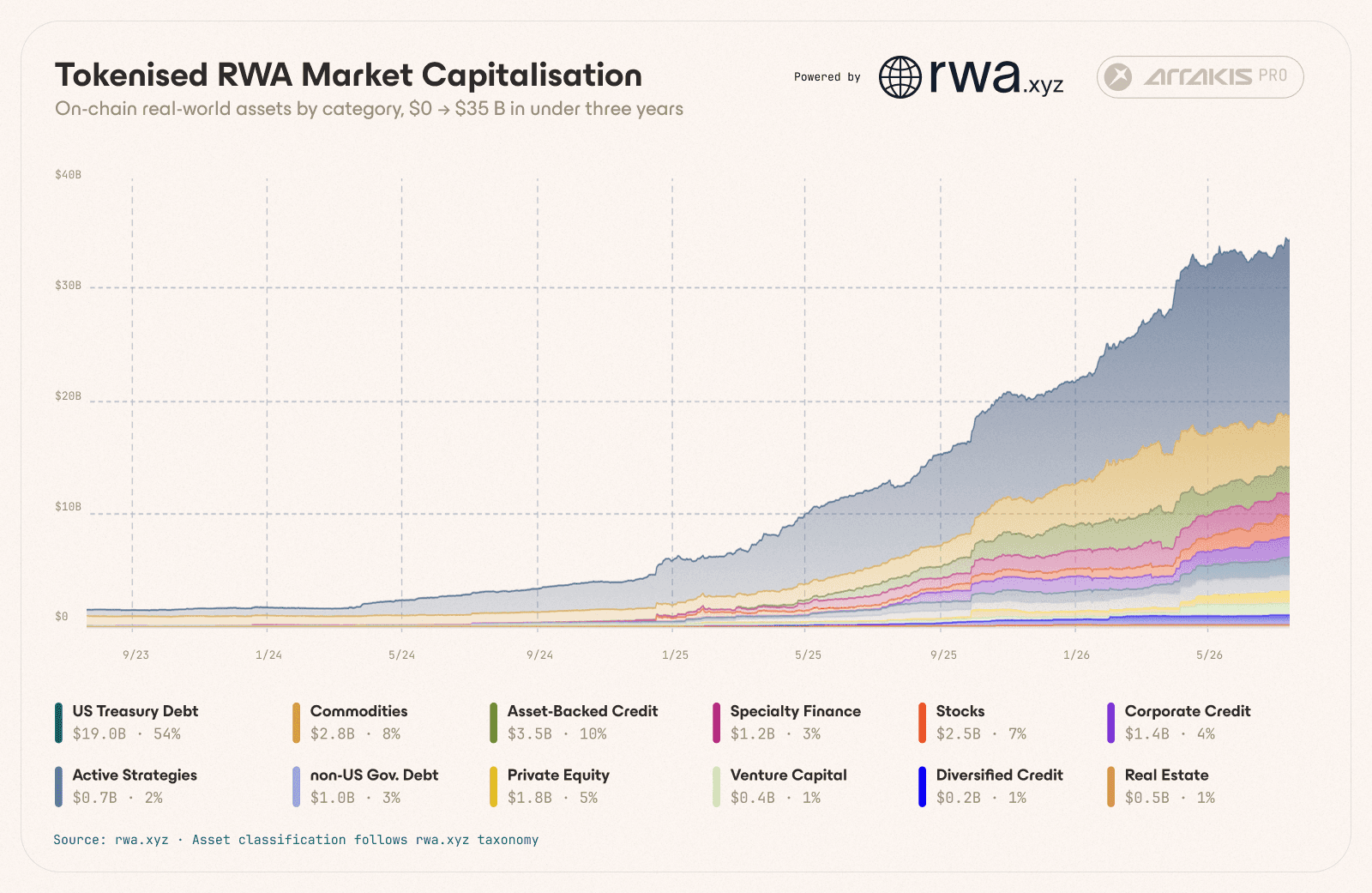
Total value of tokenised real-world assets held onchain, over time. A standing start a few years ago, and a steep climb since. Source: RWA.xyz.
But since onchain activity is pseudonymous, the most basic question about that growth has gone unanswered: who is actually buying these assets?
In this article, we set out to answer this forensically, tracing 71,697 buyers making $91.3B in gross acquisitions of ten tokenised dollar-yield products, measured against Ethena's sUSDe as a benchmark.
Tier | Products | What they are |
|---|---|---|
Benchmark | sUSDe | Ethena's staked synthetic dollar |
Tier 1 · TradFi private credit | JAAA, ACRED, mF-ONE, STAC, SCOPEx | Tokenised off-chain private-credit and CLO funds |
Tier 2 · Crypto-native credit | syrupUSDC, syrupUSDT, AA-FalconX | Onchain lending to crypto institutions (Maple, FalconX) |
Tier 3 · Tokenised treasuries | USYC, USDY | Tokenised US Treasury bills (Circle, Ondo) |
1. Who is buying?
Who is buying RWAs is a harder question than it sounds. The first wallet to receive a token is not necessarily the wallet that bought it: bundlers and other intermediary contracts route mints through the token's own contracts, obscuring who actually paid. Much of the supply then sits inside Morpho, Pendle, and other DeFi protocols rather than in an owner's account.
To see past all of this, we built a buyer ledger that traces each purchase back to the wallet that actually paid for it. That lets us attach four attributes to every buyer: a name, a size, an acquisition path and a working clock. This section works through each in turn.
Classifying RWA buyers: the capital is crypto-native, not TradFi.
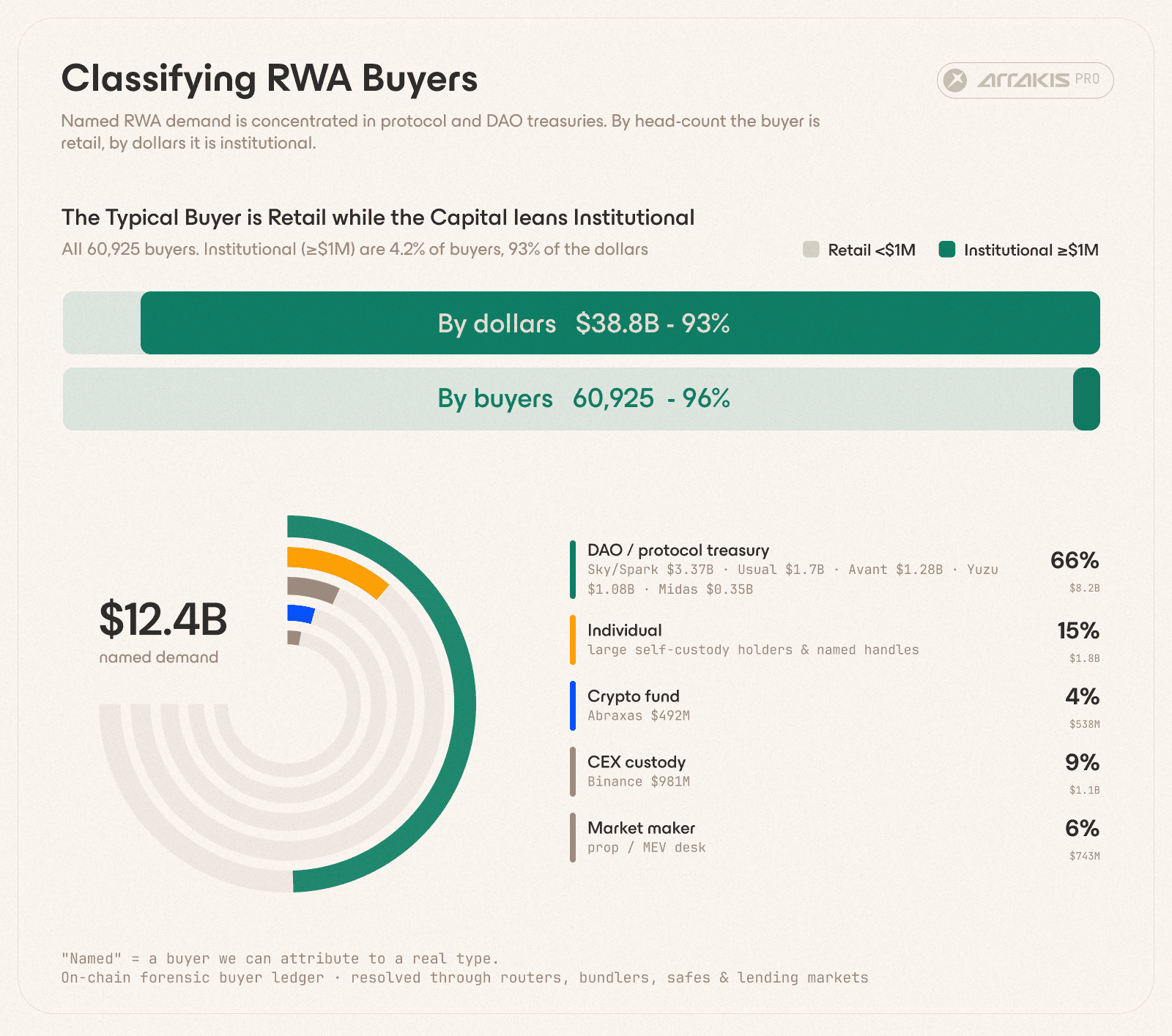
Of the demand we could attribute to a buyer type, two-thirds was protocol and DAO treasury capital, and no identified dollar was a traditional-finance allocator.
We were able to attribute roughly $12.4B of demand to a named buyer type, and every dollar of it was crypto-native. Protocol and DAO treasuries hold 66%. The rest was split across individuals, exchanges, market makers and crypto funds. No identified acquisition traced back to a traditional-finance institution, whether a pension, an asset manager, or a bank.
Issuer takeaway: your buyer is already onchain. You are selling to crypto-native treasuries and funds, not to pension funds and traditional asset managers.
4% of wallets deploy almost all of the capital
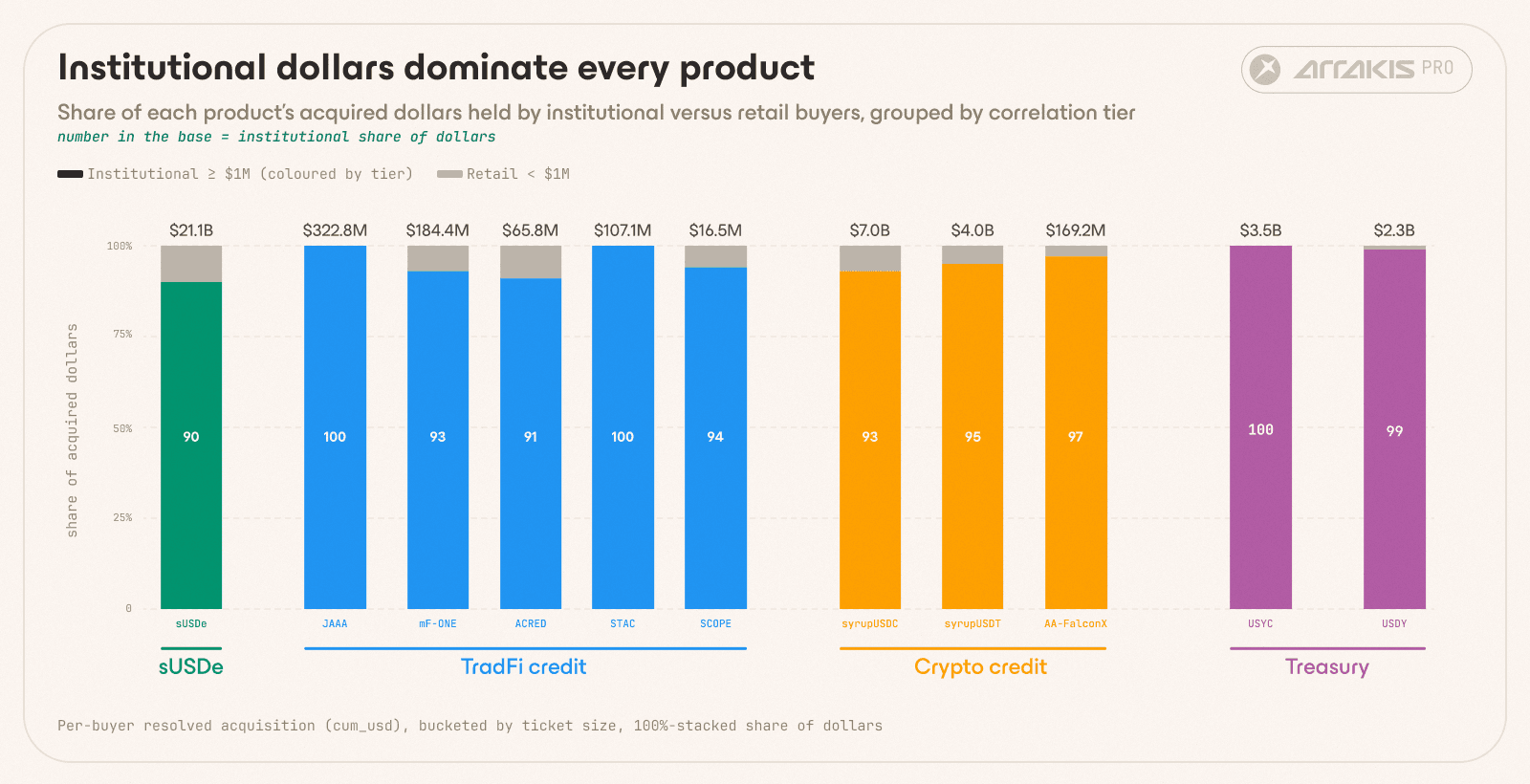
Institutional buyers (≥ $1M) are 4% of the wallets but 93% of the capital. Retail shows up only as a head-count, and mostly in sUSDe.
The absence of TradFi does not mean an absence of institutions. Across all eleven products, 2,586 buyers writing cheques of $1M or more account for more than 90% of acquired notional: the growth in RWAs is overwhelmingly the work of onchain institutions, DAOs, treasuries and crypto funds already deploying balance-sheet capital onchain.
Retail is either gated out at the KYC layer or, on the ungated products, too small to move the total. USDY is a case in point: 95.6% retail by head-count, yet those wallets hold under 1% of its value.
Of all the products we analysed, the one with by far the most retail presence is Ethena's sUSDe, which carries roughly 73% of all retail acquisition notional and about 80% of all retail buyer wallets in the set. And yet even here retail marked a minority of the capital accounting for only about 10% of sUSDe's acquired notional.
“Today's on-chain allocators are not traditional asset managers. They are more so crypto native exchanges, foundation treasuries and family offices who don't have easy access to traditional funds, so tokenized RWAs are how they reach uncorrelated yield. Large managers already have that access, which is why they see no reason to take on smart-contract risk for the same return they can get off-chain. That will change when DeFi composability lets them lever up RWA holdings for greater return.”
- Dean KD, Head of Growth, RWA.xyz
Issuer takeaway: a handful of large LPs make or break your book. Design for them, not for a crowd.
TradFi credit and treasuries draw the largest institutional cheques
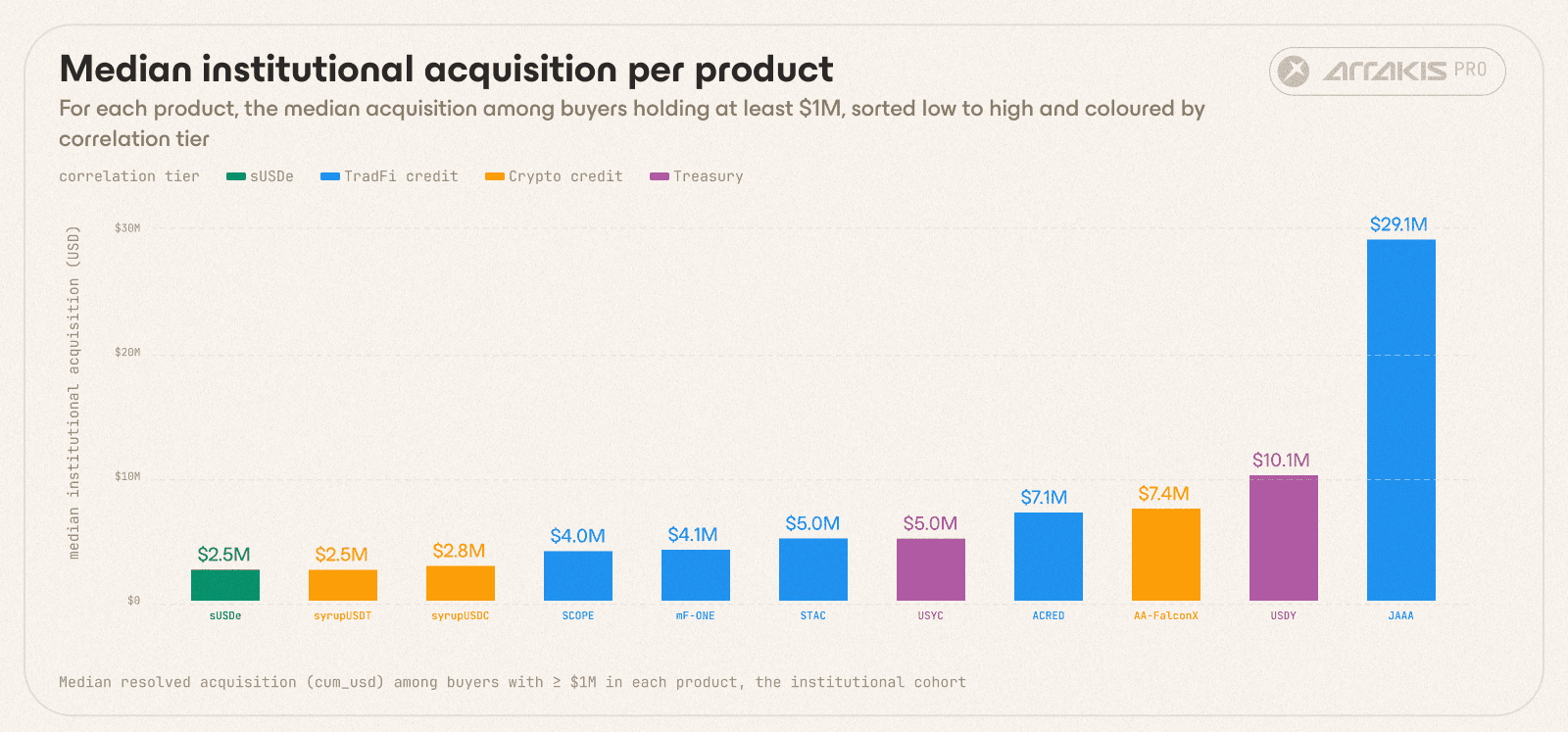
Median institutional acquisition, the cheque a buyer holding at least $1M actually writes, ordered low to high and coloured by tier. It runs from $2.5M on crypto-native carry to $29.1M on JAAA, rising with how credit-like the asset is.
Allocators size tokenised private credit and treasuries the way they would an offchain credit or treasury allocation, so those acquisitions run far larger than the ones written for crypto-native carry or credit products.
We spoke with Herwig Konings, Founder of RWA Foundation and he shared his opinion on why RWAs get the largest allocations:
“Crypto native institutions and wallet holders are pursuing RWA strategies that differ fundamentally from conventional crypto products, many of which do not align with their risk mandates or investment objectives. RWAs address that gap by bringing institutional grade asset strategies onchain, making them accessible, underwritable, and actionable for investors who are not constrained by traditional finance mandates and already have the procedures in place to manage and hold these types of assets.”
- Herwig "Happy" Konings, Founder, RWA Foundation
JAAA is a standout example here, with a median institutional cheque of $29.1M, close to three times the next-largest product and an order of magnitude above the crypto-native names.
Issuer takeaway: the more a product resembles offchain credit, the larger the individual allocation it draws. Build the primary process, custody and reporting for a handful of very large acquisitions rather than a broad book of small ones.
Most RWAs are still bought through primary subscription, not on a secondary market
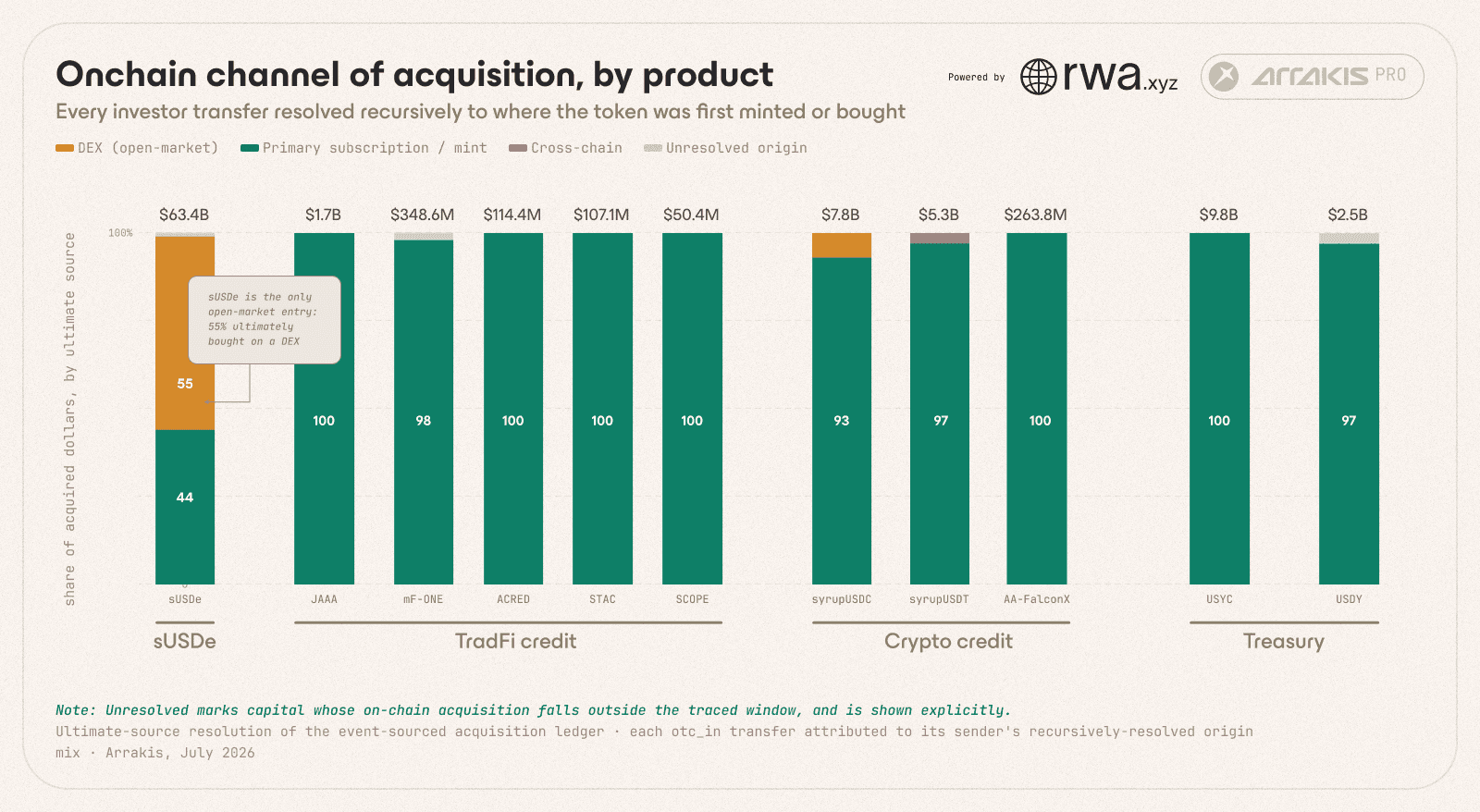
Every investor transfer resolved recursively to its origin. The RWAs are 93 to 100% primary-subscription capital, with genuine DEX entry at 0 to 6%. sUSDe is the exception, at 55% DEX.
A buyer acquires these assets in one of three ways: mint it at the issuer, buy it on a DEX, or receive it by transfer. We resolved every acquisition back to its origin, and found that the RWAs were acquired almost entirely through primary-subscriptions. Secondary open-market buying accounts for less than 6%. Only sUSDe trades onchain in a meaningful sense, with 55% of its acquisition happening through a DEX.
Secondary markets are the next frontier for real-world assets. Primary subscription already works, pulling in capital by the billion. What these tokens lack is the secondary depth to be priced continuously, posted as collateral and composed with the rest of onchain finance. That depth is the largest opening left in the RWA market.
Issuer takeaway: your token's reach across DeFi is capped by its secondary liquidity. A deep, NAV-priced secondary market is what turns a subscription product into a composable onchain asset.
The buyers operate in European and Asian hours
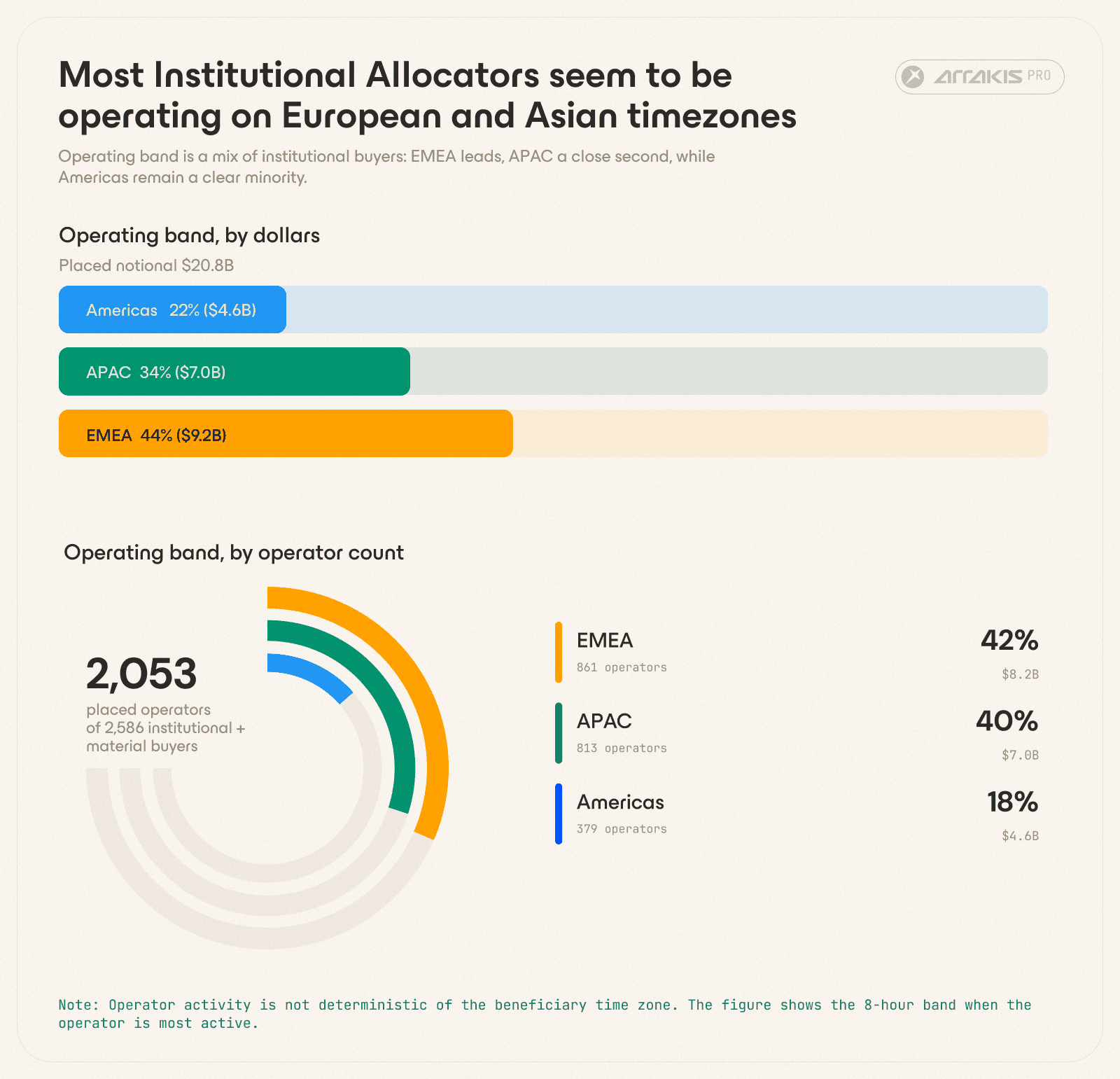
Operating band is a mix of institutional buyers: EMEA leads, APAC a close second, Americas a clear minority (42 / 40 / 18%).
We split each day into three eight-hour windows, Americas, EMEA and APAC, and assigned each significant allocator to the window in which it transacts most.
42% of the buyers were operating in EMEA hours and 40% in APAC, leaving the Americas at 18% of wallets, roughly one in five.
Judging by when their wallets are most active, these buyers likely operate offshore: EMEA and APAC hours together account for over 80% of them, with the Americas a clear minority. This is an indication that US credit and treasury products onchain are more attractive to non-US investors, which are less accessible to them otherwise.
Issuer takeaway: your buyers may be offshore. Concentrate BD, coverage and support around European and Asian hours.
2. Following the capital
Having established that the buyers are crypto-native institutions subscribing through primary channels, two questions follow: where did the money come from, and what does it do once the asset is bought?
Capital origination: unattributed capital is primarily CEX-funded and DeFi-native.
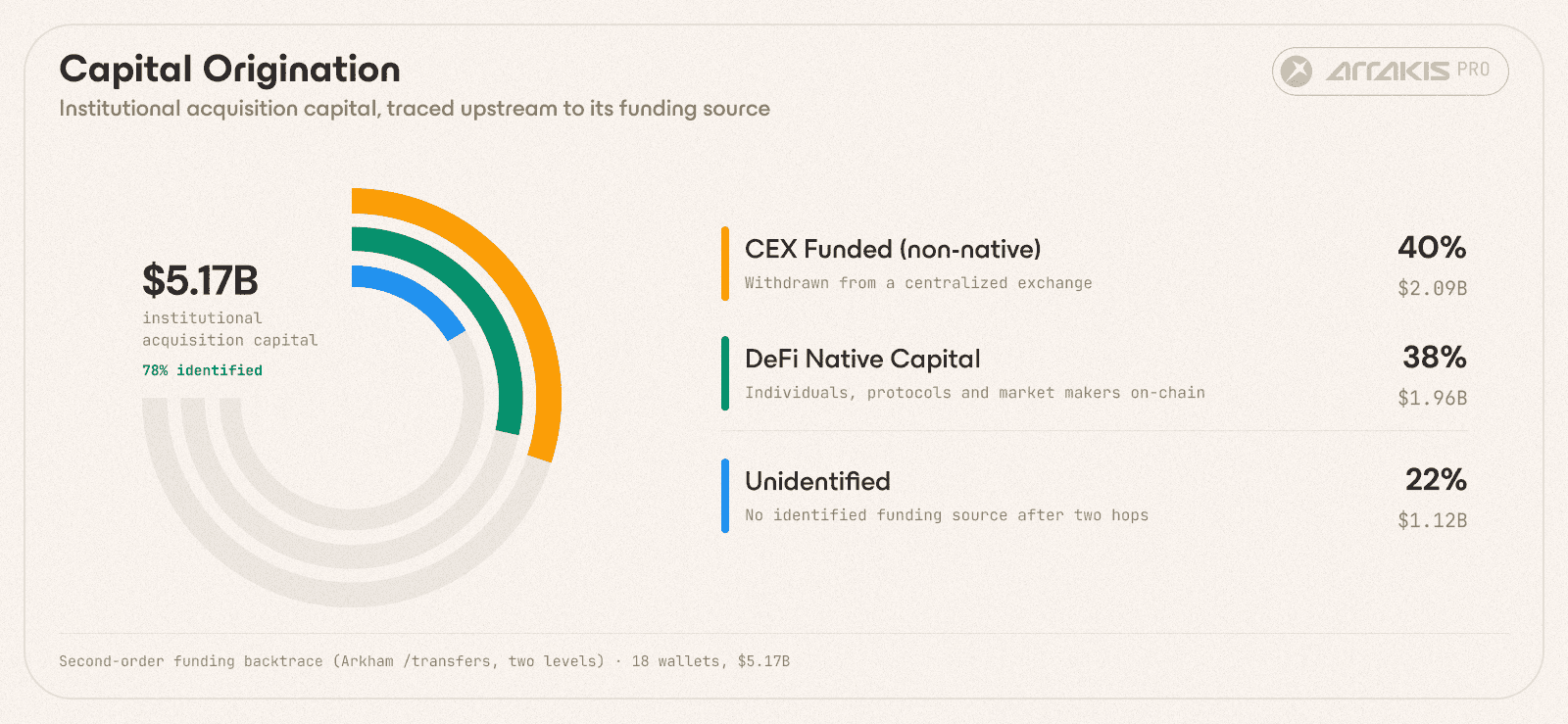
Of $5.17B in otherwise-unattributed institutional capital, 78% resolves after two hops: 40% funded from a CEX, 38% DeFi-native, 22% unidentified.
Many of the largest buyers from our part-one attribution carried no entity label, so we traced their funding back two hops. Out of $5.17B of the otherwise unattributed institutional-size capital, exchange-funded capital is the largest slice at 40%, with Binance at $1.12B and Coinbase at . DeFi-native capital (named individuals, entities and market-maker desks) accounts for 38%. The remaining 22% stays unidentified even beyond two hops.
Issuer takeaway: Even after two hops of analysing wallet funding, no verified non-crypto-native funder was identified, which reinforces the conclusion that the vast majority of RWA buyers are crypto-native funds and treasuries.
Which stables are used to acquire these assets?
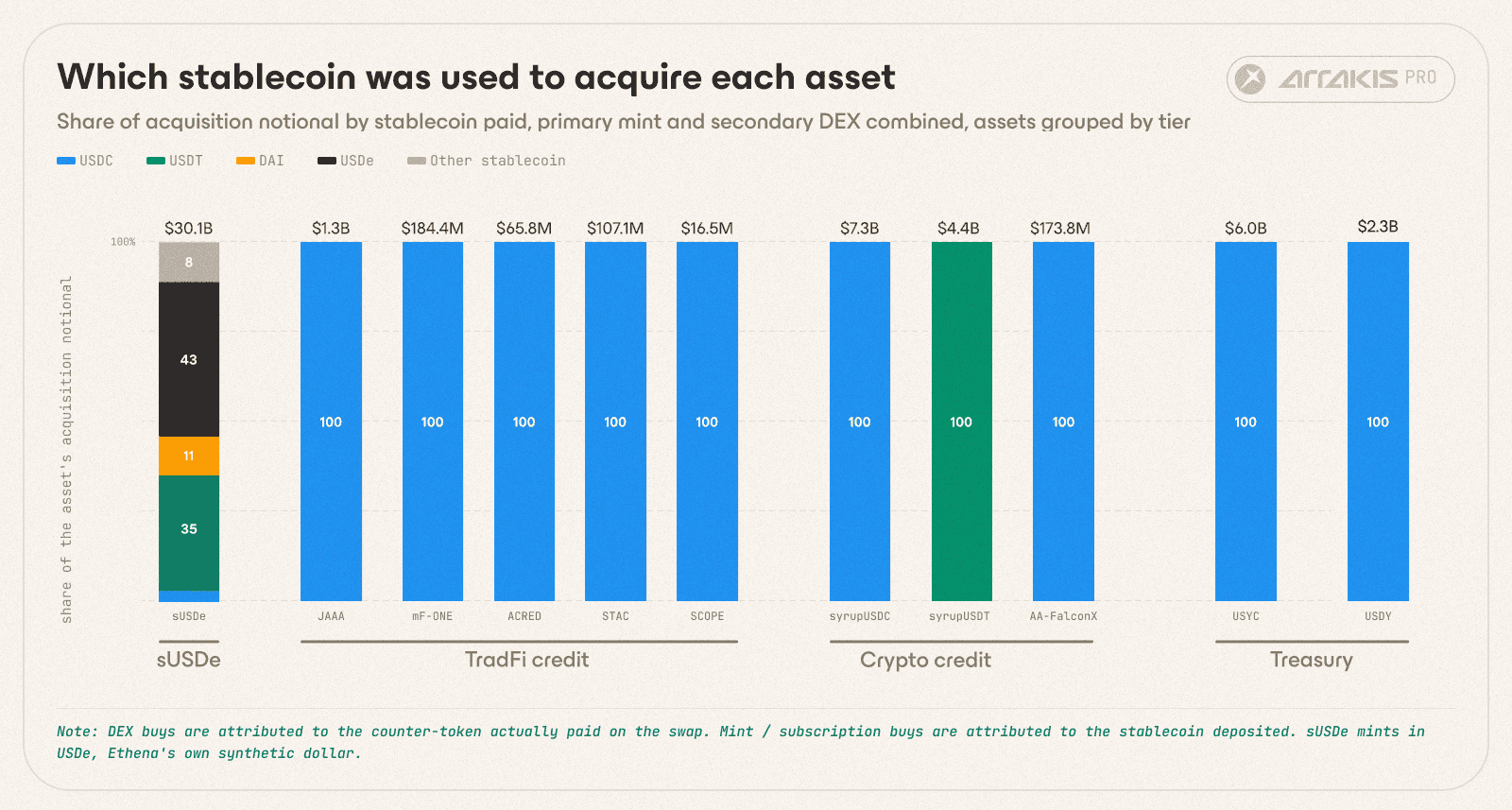
Stablecoin paid to acquire each asset, primary and DEX summed. Across the credit and treasury book USDC funds about 80% ($17.4B) and USDT most of the rest ($4.4B), almost all of that USDT being syrupUSDT. sUSDe is the exception, minted by staking USDe rather than bought with a mainstream stablecoin.
Almost all RWA acquisitions settle in USDC: USDC funds about 80% ($17.4B) of the book. USDT makes up most of the remainder ($4.4B), with ~99% of it being used in syrupUSDT.
Maple shows this most clearly, since it runs both a USDC and USDT product as a single issuer with identical strategies.
Metric | syrupUSDC | syrupUSDT |
|---|---|---|
Acquired (stablecoin paid) | $7.3B | $4.4B |
Distinct buyers | 9,603 | 3,130 |
Median ticket | $4,009 | $10,502 |
Shared holders (1,168), share of buyers | 13% | 40% |
Shared holders, share of acquisitions | 44% | 60% |
syrupUSDC is the larger and more adopted asset of the two. While syrupUSDT’s buyers appear to largely be institutions that already hold syrupUSDC. The USDT unit reaches almost none of syrupUSDC's retail tail, and re-denominates existing demand rather than forming a new base of it.
Issuer takeaway: denominate in USDC first. It is the acquisition default for four-fifths of the established RWAs, and the currency with the deepest DEX markets and looping ecosystem behind it.
Majority of wallets buying RWAs are freshly funded.
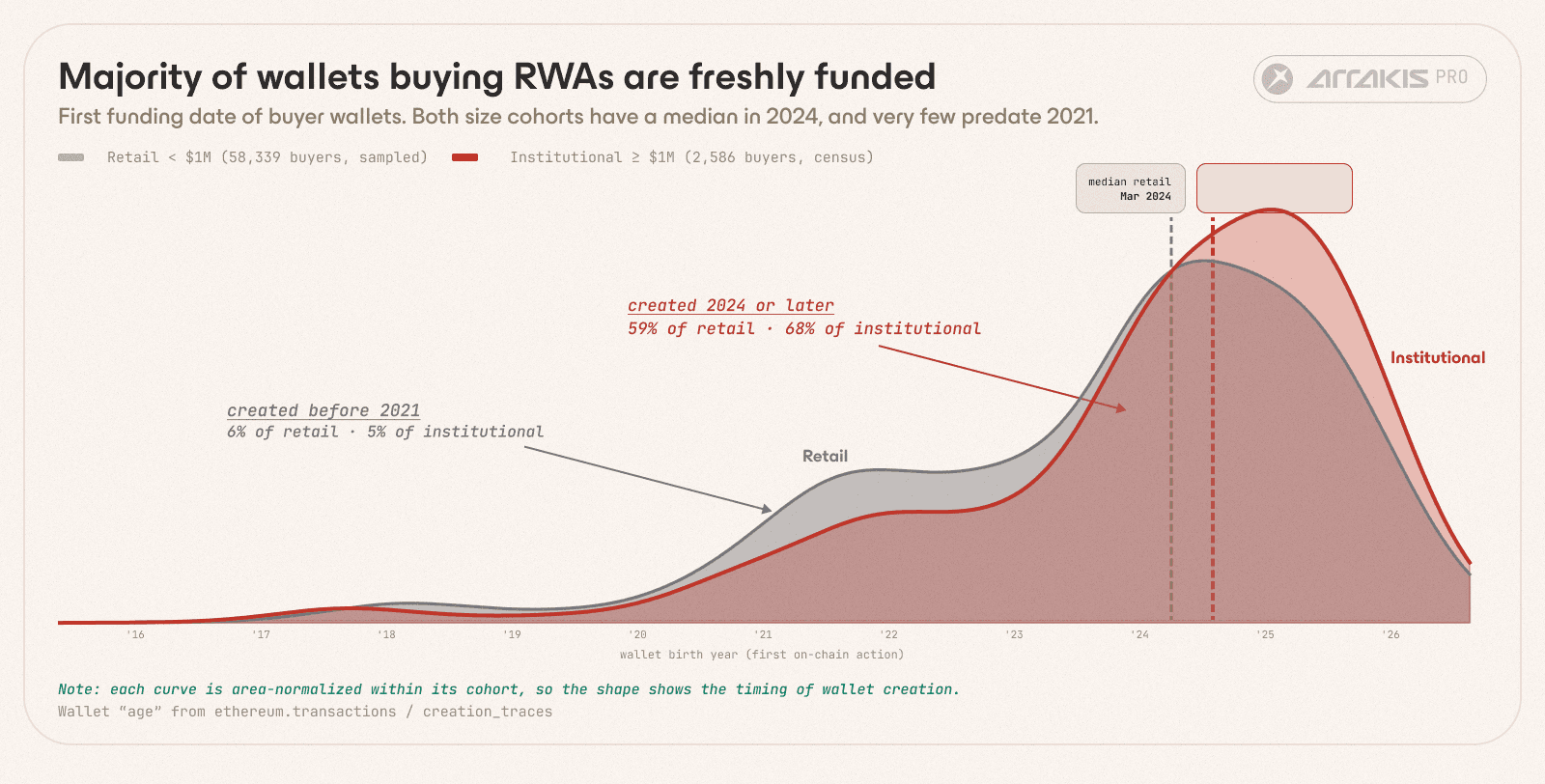
Both size cohorts have a median wallet dating to 2024: retail around March 2024, institutional around July 2024. Very few predate 2021.
One clear pattern we observed across the buyer set is how new the wallets are. Both retail and institutional wallets show a median wallet inception in 2024. Very few predate 2021.
The majority of capital moving into RWAs does not appear to be legacy crypto wealth taking profit and rotating into safer yield products. It is fresh, crypto-native capital, deployed through clean wallets that allocators spin up for the purpose.
Issuer takeaway: your core allocators are not last cycle's BTC and ETH whales. The capital entering RWAs is fresher and more specialised, and it arrives through purpose-built wallets rather than aged addresses.
Buy, then what? Terminal use of the capital.
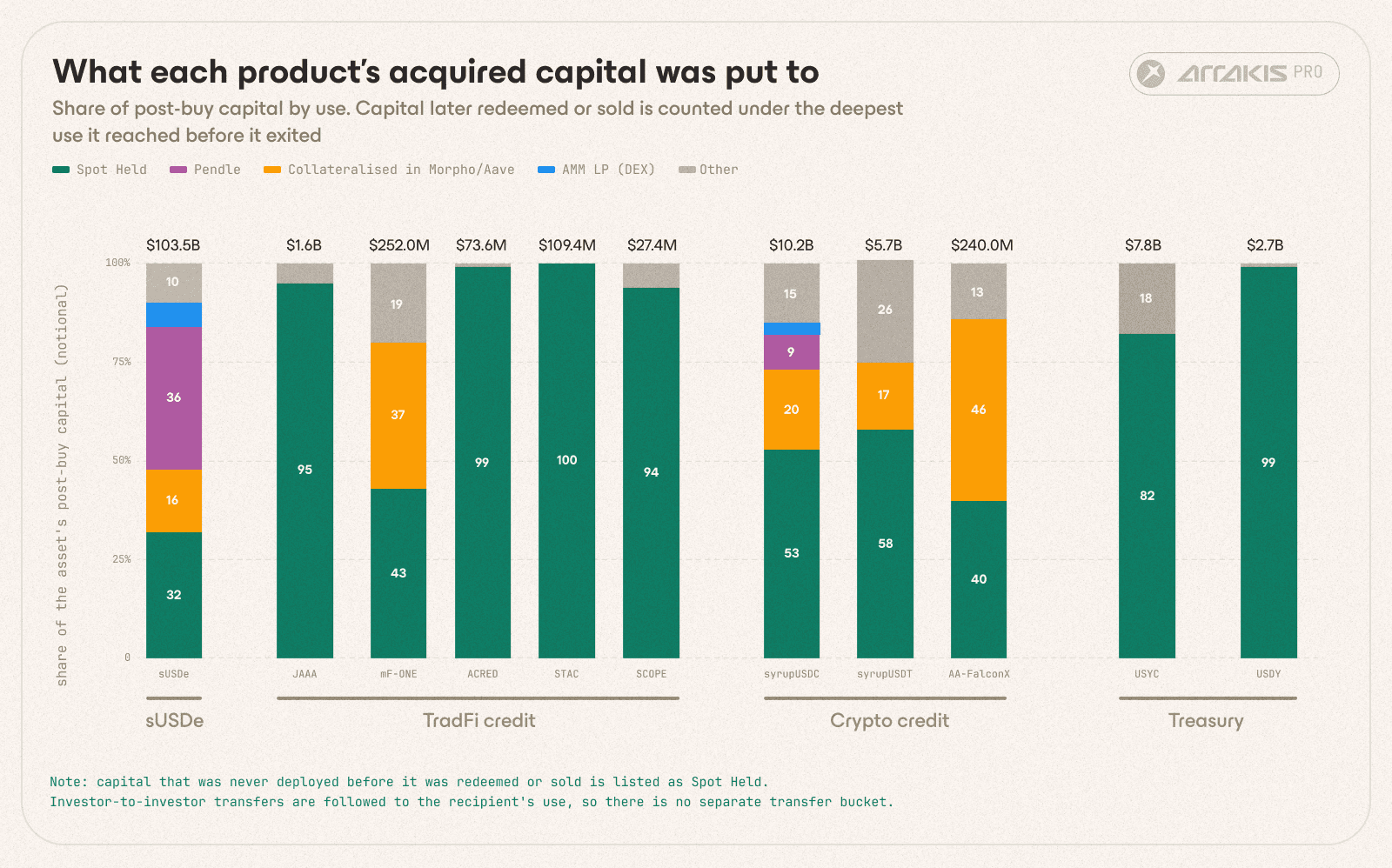
Where each product's capital sits as of 7th July 2026. A point-in-time snapshot of usage. sUSDe is the only product genuinely deployed across DeFi, split across Pendle, spot held, collateral and AMM. The tokenised credit and treasury names are allocated mostly in spot, with AA-FalconX and mF-ONE being the collateral-heavy exceptions.
These assets hold a defined NAV and redeem close to it, so there is little reason to sell them over the counter. We screened every large transfer for a matching stablecoin counter-leg to validate this, and only about 1.3% looked like a real OTC sale. So we treated the rest as internal moves and followed each dollar to where it finally lands.
Most of it is held in spot, earning the base yield. A minority is posted as collateral to borrow against, and a small slice goes to Pendle to acquire fixed rate versions of the product.
sUSDe is the only token spread across all of these. The credit and treasury names are almost entirely in spot, apart from mF-ONE and AA-FalconX which have a significant amount pledged as collateral for leverage.
“The interesting part is how naturally institutions have started treating tokenized credit as collateral. When an asset becomes part of how someone manages capital day to day, it sticks around - and that says more than any TVL number. AA_FalconXUSDC already works this way, and I'd expect the rest of the category to follow.”
- Matteo Pandolfi, Co-Founder & CEO of Pareto
Issuer takeaway: once bought, most RWA capital earns its yield in spot. A minority is put to work as leverage collateral, and only a small remainder reaches other novel DeFi uses such as Pendle, managed strategy vaults or AMM LPs.
How much capital is levered?
Leverage looping has been one of the biggest contributors to TVL growth in classic DeFi yield products, from LSTs and LRTs to sDAI. As RWAs mature and become more composable with DeFi lending markets, the same is expected to follow for these assets.
That said, we measured how far this has actually gone today: how much of each product is posted as collateral in lending markets, and how much stablecoin debt has been drawn against it.
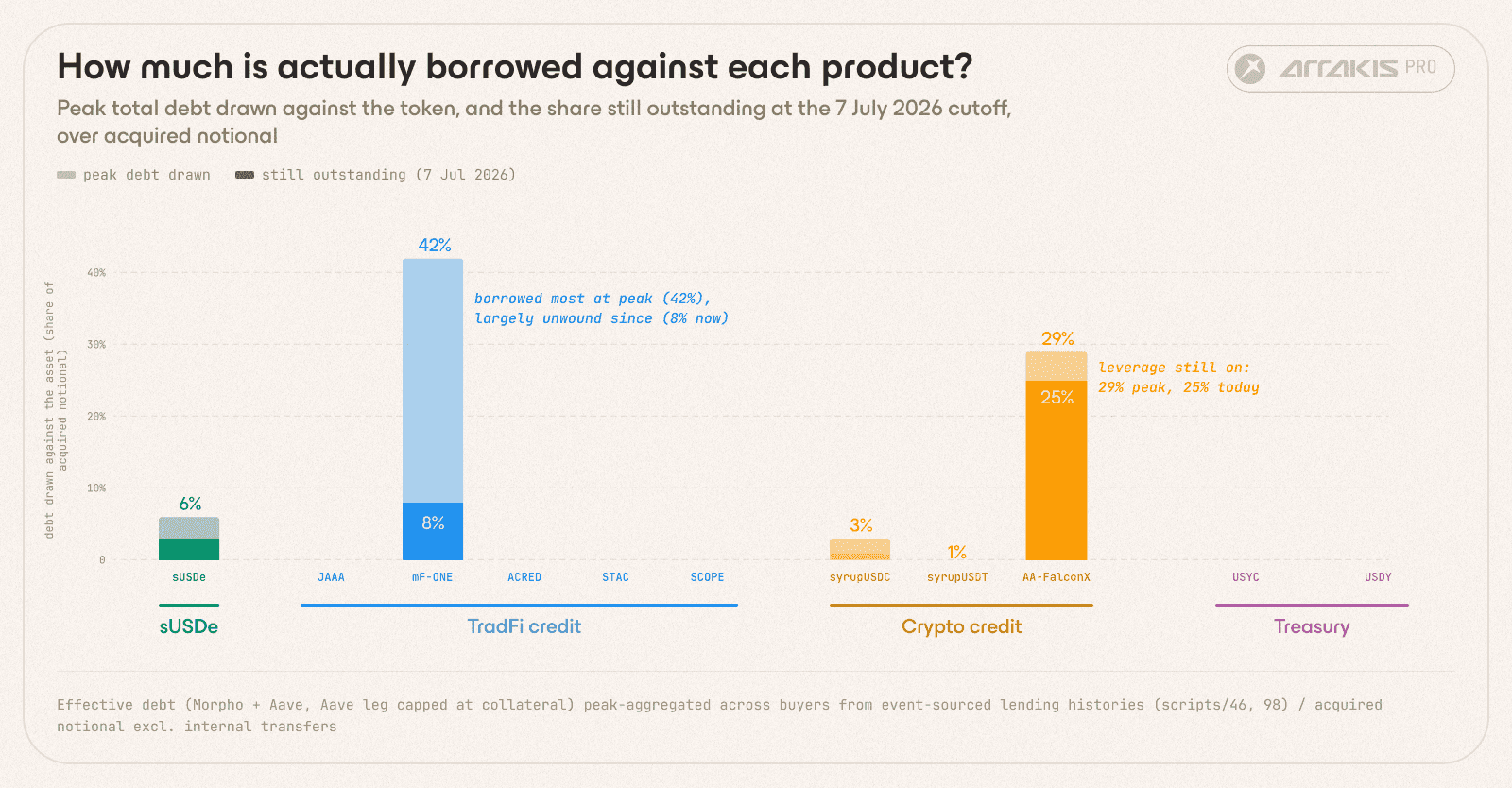
Actual debt drawn against each product as a share of its acquired notional: the light bar is the peak the book ever carried, the solid bar what is still outstanding at the 7 July 2026 cutoff. mF-ONE peaked highest near 42% but has unwound to 8%, while borrowing by holders against AA-FalconX decreased only slightly, from 29% to 25% as of July 7.. sUSDe and the syrup pools stay in low single digits; the treasuries and most tokenised credit funds are at zero.
Leverage can only occur on assets which have a lending market to borrow against, and most RWAs in our list had none. Almost all of the borrowing sits in two small credit products. mF-ONE was borrowed against the most: once it listed on Morpho, its debt climbed to 42% of the token's notional before holders unwound it back to 8%.
AA-FalconX is an outlier in sustaining external borrowing demand: holders had borrowed against 25% of acquired notional as of July 7, versus a 29% peak, the highest current level in our analysis.
On other assets there is little to see. sUSDe and the syrup pools are in the low single digits, and the treasuries and clean credit funds show no borrowing at all.
Issuer takeaway: a lending market is what puts leverage on your token. Listing on Morpho or Aave with available credit-side liquidity enables holders to leverage for higher APYs.
TradFi credit and treasuries are the stickiest capital in the set.
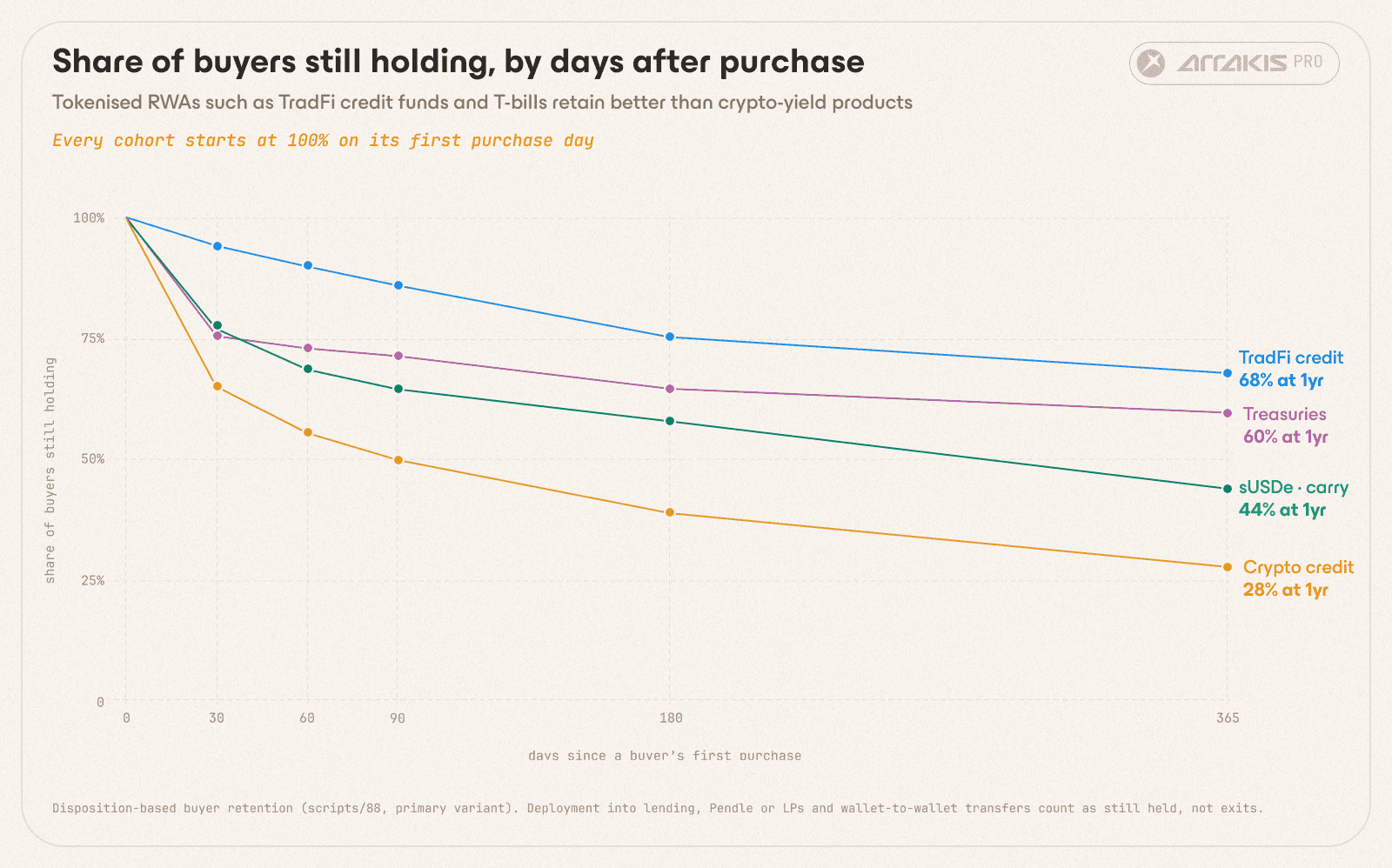
Retention to a genuine exit (issuer redemption or DEX sale). Deployment into lending, Pendle, or LPs and wallet-to-wallet transfers count as still held.
Retention here counts only a genuine exit, an issuer redemption or a DEX sale, so deploying to Morpho or moving between your own wallets still counts as holding. On that basis the asset tiers separate clearly on this metric a year out from their acquisition.
Tokenised RWAs retain best, with the TradFi credit funds retaining 68% of their buyers at one year and the treasuries 60%, crypto-native credit and carry products see their buyers churn the fastest, down to 28% by the end of the first year.
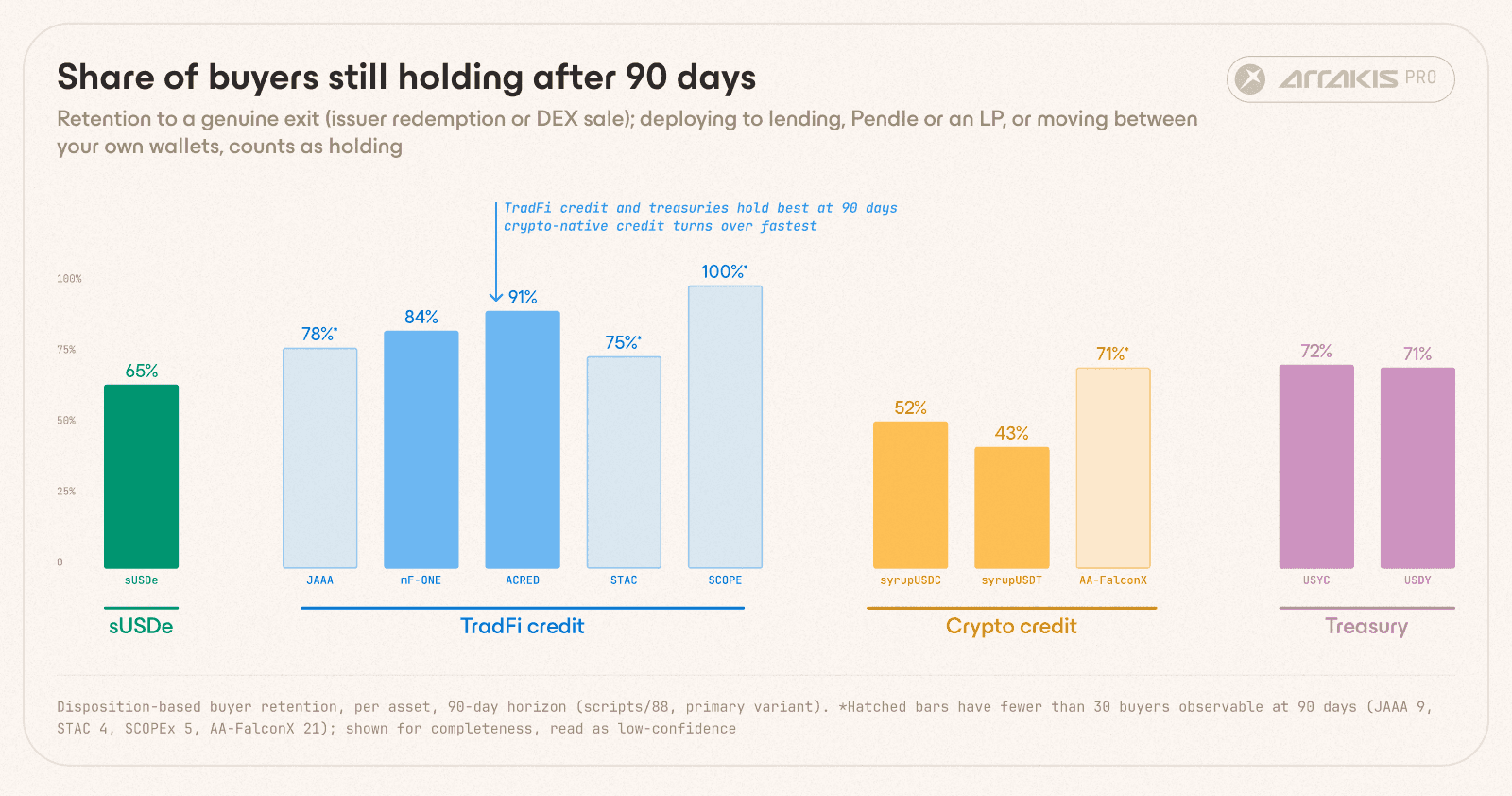
Share of each product's buyers still holding 90 days after purchase, by asset. TradFi credit (ACRED, mF-ONE) and the tokenised treasuries (USYC, USDY) hold best, sUSDe falls in the middle, and the crypto-native syrup pools turn over fastest. Hatched bars (JAAA, STAC, SCOPEx, AA-FalconX) have fewer than 30 buyers old enough to observe at 90 days, hence should be read with lower confidence.
Issuer takeaway: The stickiest capital is tokenised treasury and private-credit money, and holders of crypto-native products churn the fastest.
3. What yield are allocators chasing?
We measured the composite net APY that each product's largest buyers earn on the capital they have deployed onchain.
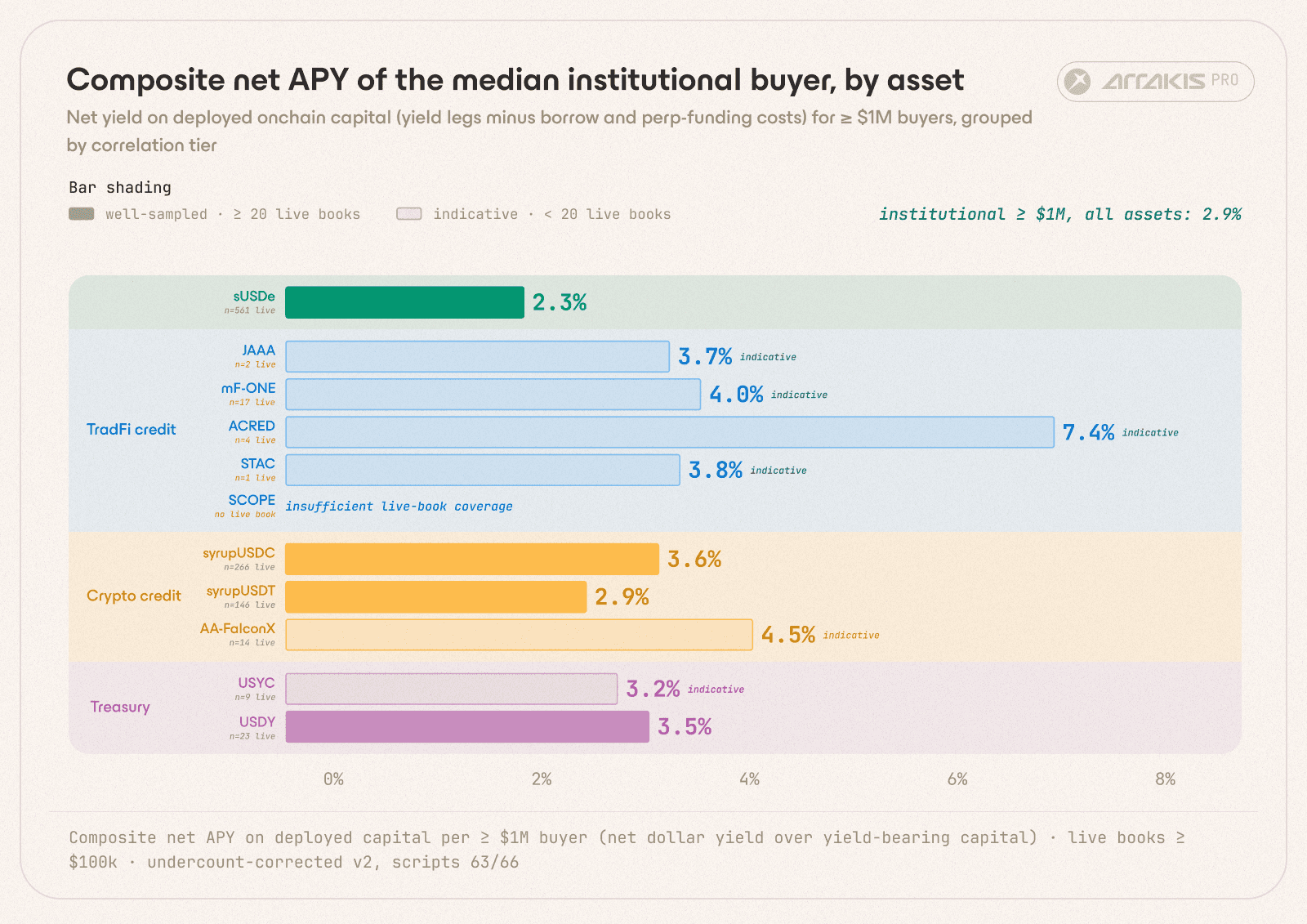
What each product's biggest buyers keep across their deployed onchain capital, net of borrowing and funding costs, not the yield the product itself advertises.
What the biggest allocators currently keep on their deployed onchain capital, net of borrow and funding costs and with idle cash excluded, by product type:
If your product looks like… | …its institutional buyers keep (net, on deployed capital)* |
|---|---|
Synthetic-dollar carry (sUSDe) | ~2.3% |
Crypto-native credit (syrupUSDC/USDT, AA-FalconX) | ~2.9 to 4.5% |
Tokenised treasuries (USYC, USDY) | ~3.2 to 3.5% |
TradFi private credit (JAAA, mF-ONE, ACRED) | ~3.7 to 7.4% |
Reflects estimated net returns from observed onchain deployment strategies, including looping where applicable, after borrowing and funding costs. These figures are not the standalone APYs of the underlying products.*
The closer a product is to offchain credit, the more its buyers tend to seek in yield, rising from about 2.3% on synthetic-dollar carry to 7.4% on the gated private-credit funds.
Issuer takeaway: the capital investing in your asset category is currently earning within these bands. Use it as context for where you would enter.
Note: This is not indicative of the individual hurdle rates that allocators may have for your product segment. Allocators may report completely different hurdle rates accounting for the risk and stage of your product. These figures also do not include any incentives or offchain rewards that may be distributed to the allocator. They reflect what buyers earn on deployed capital across all their onchain positions, not a product's headline yield.
Conclusion: RWA Buyer Archetype
Although this analysis was done over a limited sample, it did reveal a characteristic pattern in how RWA products are bought. We have compiled those patterns below, with what each may mean for your product.
What we measured | The RWA buyer | What it means for your product |
|---|---|---|
Identity | A crypto-native institution: a DAO, protocol treasury or crypto fund. No pension fund, family office, bank or TradFi asset manager appeared. | You are selling to onchain institutions, not to TradFi. |
Concentration | About 4% of wallets, each writing $1M or more, hold roughly 93% of the capital. | A handful of institutional size LPs would scale your AUM. Design the product for them, not retail. |
Ticket size | Scales with how TradFi credit-like the asset is, from about $2.5M on crypto carry to $29M on JAAA. | If you’re building a TradFi credit tokenisation product, expect a few really large deals to actually move the needle. |
How they acquire | Almost entirely primary subscription, with 0 to 6% bought on the open market. | Secondary liquidity is a wedge in the market. |
Settlement | USDC funds about 80% of the book. | Denominate in USDC if possible. |
Origin and base | Fresh 2024 wallets, funded from exchanges and DeFi desks, active in European and Asian hours. | New money, run offshore. Concentrate distribution in EMEA and APAC markets. |
What they do with it | Held in spot for yield. Leverage and composability appear only where a lending market exists. | Deliberately wire your token into lending and DeFi venues to unlock sticky composable use cases for your product. |
What keeps them | TradFi credit and treasuries hold the longest, while crypto-native products turn over fastest. | Focus especially on retention if you’re building a crypto-native credit or carry product. |
With the caveats we mentioned in the article, this table can be treated as a guide to structuring your RWA product around the buyer behaviour we observed, across 71,697 buyers and eleven established products.
This is still a young buyer base, most of its wallets date to 2024 and it is growing fast. As onchain finance matures, this class of RWA buyers will grow with it, and the issuers who design around how it behaves today are the ones best positioned to win it tomorrow.