Hyperliquid


Inside the month-long pre-IPO market for SpaceX, and what it says about the IPO summer ahead.
TL;DR
A month ago, pre-IPO price discovery ran on a single venue. SpaceX converted to a listed equity on 12th June with its perpetual quoted on roughly a dozen venues at once. We tracked six of them tick by tick through the open.
Flow: $3.23B of $SPCX traded across the six venues through 11th June.
Liquidity: OKX carried the deepest book into the open, around $1.28M at ±50 bps after a roughly sixfold build in the final day, while trade.xyz thinned to ~$144k.
Accuracy: Every venue's final pre-listing mark sat above the open. Ventuals was closest at +15.3% and trade.xyz widest at +18.2% versus the $150.00 Nasdaq open, and +7.5% to +10.1% versus the first-30-minute VWAP of $160.97.
Pre-IPO perpetuals went from a single-venue novelty to a contested price-discovery layer for private companies in the four weeks between Cerebras and SpaceX.
1. From One Venue to a Dozen
Welcome to Volume 2 of our Pre-IPO Summer series, where we analyse the largest listing by market value and the pre-IPO markets that formed around it. In our previous volume, we covered the Cerebras ($CBRS) IPO on 14th May.
In May, anyone who wanted early exposure to $CBRS had only one option: the pre-IPO perp market on trade.xyz. Quantinuum ($QNT) followed three weeks later, and this time pre-IPO markets launched on a handful of additional venues.
While these earlier IPOs were pivotal in shaping the early pre-IPO ecosystem, SpaceX operated on a much larger scale: roughly a dozen venues launched a $SPCX market before the IPO, and we tracked six of them through the open.
A pre-IPO perpetual is a simple synthetic instrument. It is a cash-settled perp contract on the stock of a company that has not listed yet. The holder owns no share and no right to an allocation, only a payoff tied to where the stock trades once it goes public. A normal perpetual stays anchored to its underlying through funding payments, but a pre-IPO contract has no stock price to anchor to. So venues run funding at a fraction of its usual strength and let the price float to wherever the market expects the stock to open.
The contract ends in one of two ways. When the company lists, it becomes a standard equity perpetual and arbitrage pulls it to the stock price. If the listing falls through by the contract's deadline, positions settle in cash at the contract's own recent average price.
The six venues we tracked differed in contract design but operated roughly along these lines:
Venue | Type | Contract | Quote basis | Notes |
|---|---|---|---|---|
Trade.xyz | DEX (Hyperliquid HIP-3) |
| Per share (~$150-175 in June) | Listed all three pre-IPO perps to date |
Ventuals | DEX (Hyperliquid HIP-3) |
| Company valuation (~$1,950-2,175B, i.e. $1.95-2.18T) | Dedicated pre-IPO platform, late-May |
Lighter | DEX |
| Company valuation | - |
Aster | DEX |
| Per share | - |
Binance | CEX |
| Per share | Largest share of pre-listing flow |
OKX | CEX |
| Per share | First venue live (7th May), rebased its contract on 2nd June |
2. Cross-Venue Analysis
We scored the six venues on three questions: who could absorb size, where the order flow went, and who forecast the opening price best.
Our order-book capture began on 8th June, so book comparisons cover the listing week. Volume and price series run from each venue's respective launch.
2.1 Who Can Absorb Size
The centralised exchanges quoted the tightest spreads. Through 8th to 10th June, the two deepest books belonged to trade.xyz and OKX, each holding around $200k of resting size at ±50 bps of mid while every other venue sat under $80k.
Venue | Spread, 8-10 Jun (bps) | Spread, 11-12 Jun (bps) | Depth at ±50 bps, 8-10 Jun | Depth at ±50 bps, 11-12 Jun |
|---|---|---|---|---|
OKX | 0.64 | 0.60 | $199k | $1.28M |
Binance | 1.15 | 0.60 | $79k | $100k |
2.52 | 3.0 | $201k | $150k | |
Aster | 6.15 | 4.80 | $59k | $58k |
Lighter | 55.3 | 60.8 | $59k | $78k |
Ventuals | 38.5 | 51.6 | $3.1k | $3.1k |
Medians per window. The 11-12th June window runs to the morning of the listing.
A retail-sized order filled cheapest on OKX or Binance throughout. Institutional size sat on trade.xyz and OKX, and into the open it sat on OKX alone: from 11th June OKX's resting depth grew more than sixfold to $1.28M while trade.xyz thinned to $150k. The deepest book into the cross was a centralised one.
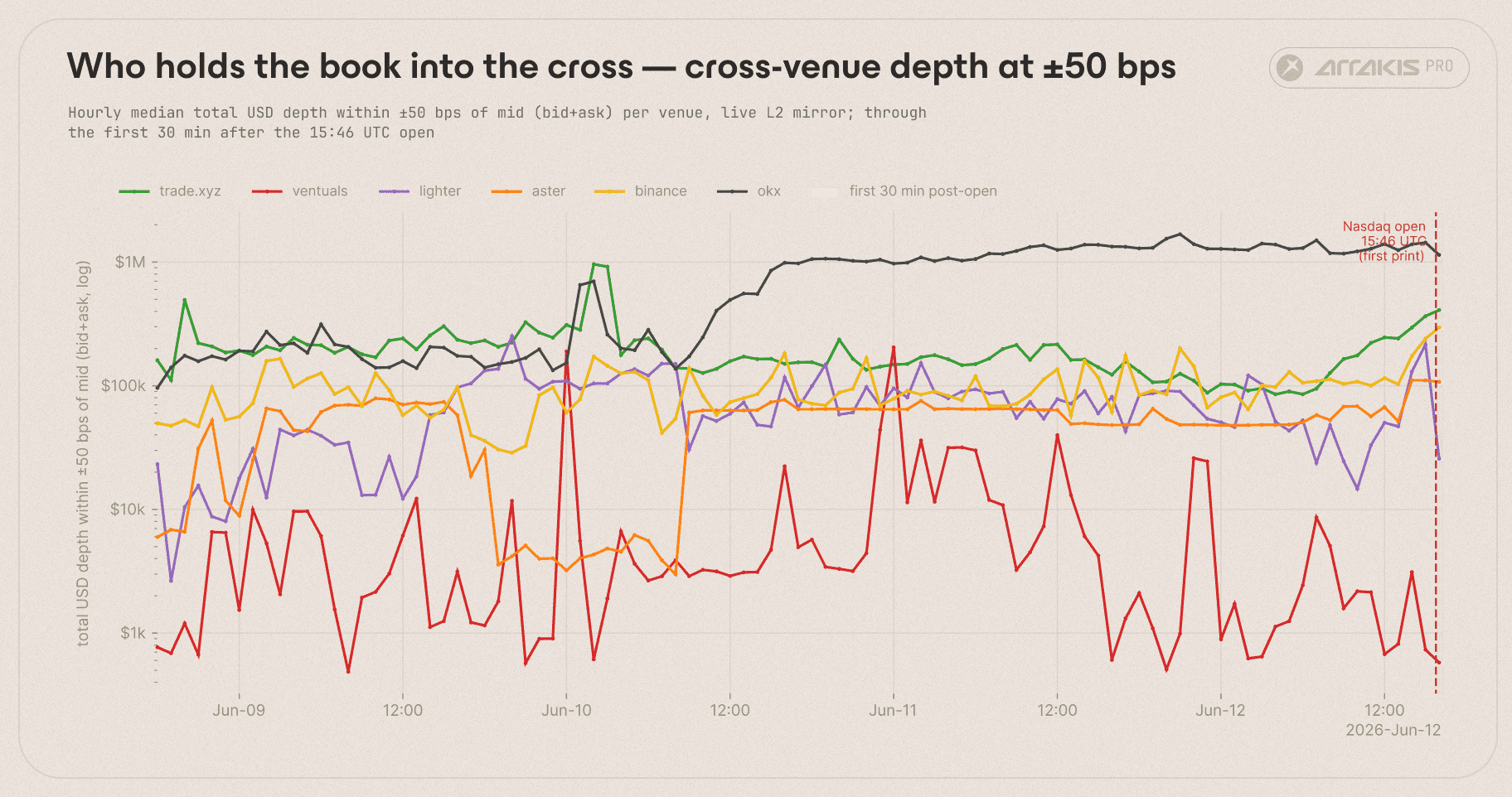
Into the 15:46 UTC open OKX held the deepest book, around $1.28M at ±50 bps after a sixfold build, while trade.xyz thinned to ~$150k; the deepest book at the cross was a centralised one.
2.2 Where the Flow Went
Venue | Volume | Share |
|---|---|---|
Binance | $1.77B | 54.7% |
$728M | 22.5% | |
OKX | $703M | 21.8% |
Aster | $15M | 0.5% |
Ventuals | $12M | 0.4% |
Lighter | $5M | 0.2% |
Total | $3.23B | 100% |
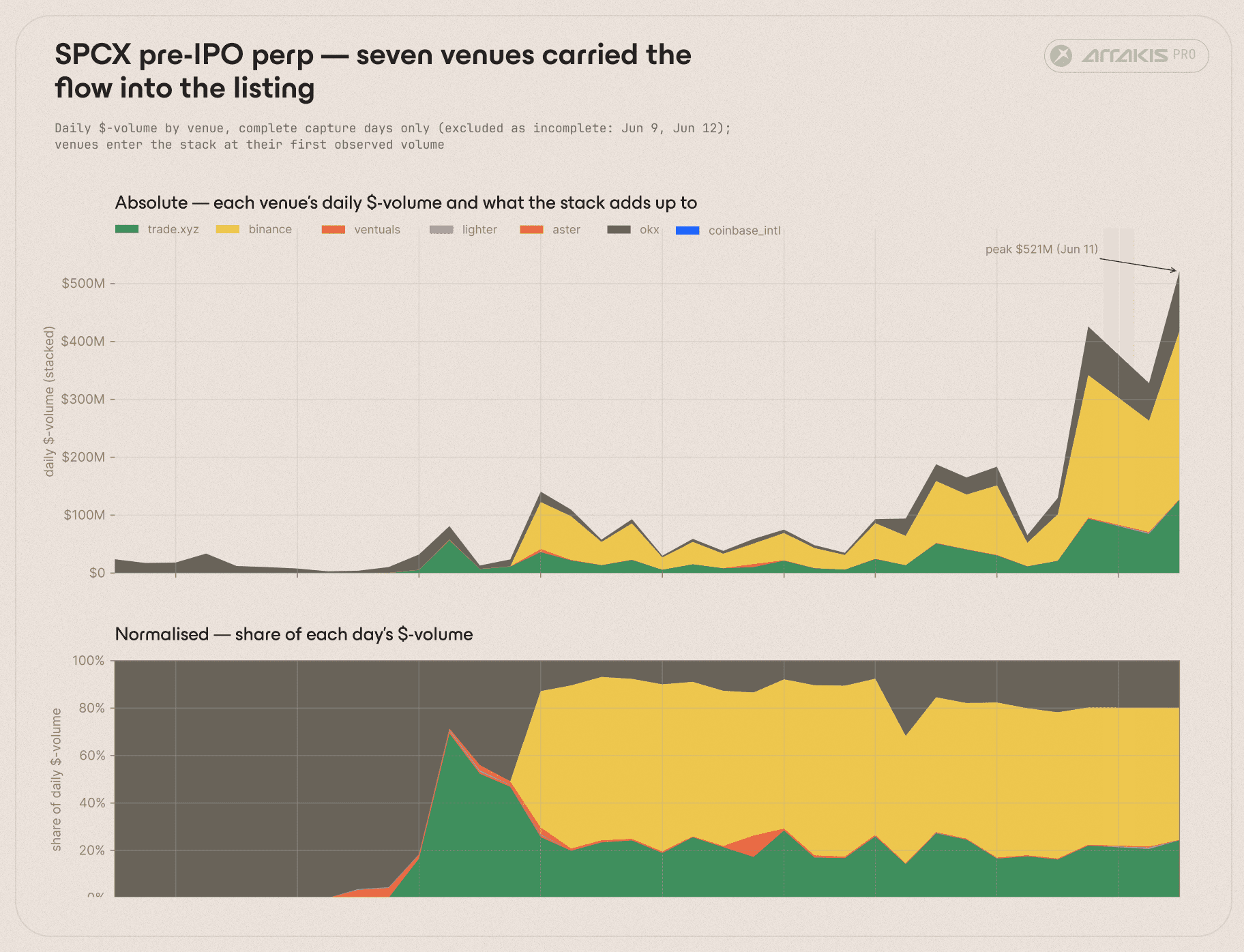
Complete capture days, 7th May through 11th June. Centralised exchanges carried 76.5% of the flow, onchain venues 23.5%.
The lead changed hands twice. OKX was first to market, quoting a SpaceX contract from 7th May. Trade.xyz listed on 17th May and led within a day, taking 69% of daily flow. Binance listed on 21st May and took the lead the same day, peaked at 72% of daily flow on 31st May, and carried 55 to 60% into listing week. The market grew under all of it: daily flow in listing week ran more than six times the launch-week average, so trade.xyz's turnover kept rising even as its share settled near a fifth.
The flow and the depth lived on different venues. Binance took more than half the volume on a $79-90k book, while OKX, third by share, built the deepest book into the open. The volume went where the distribution was, and size had to trade somewhere else.
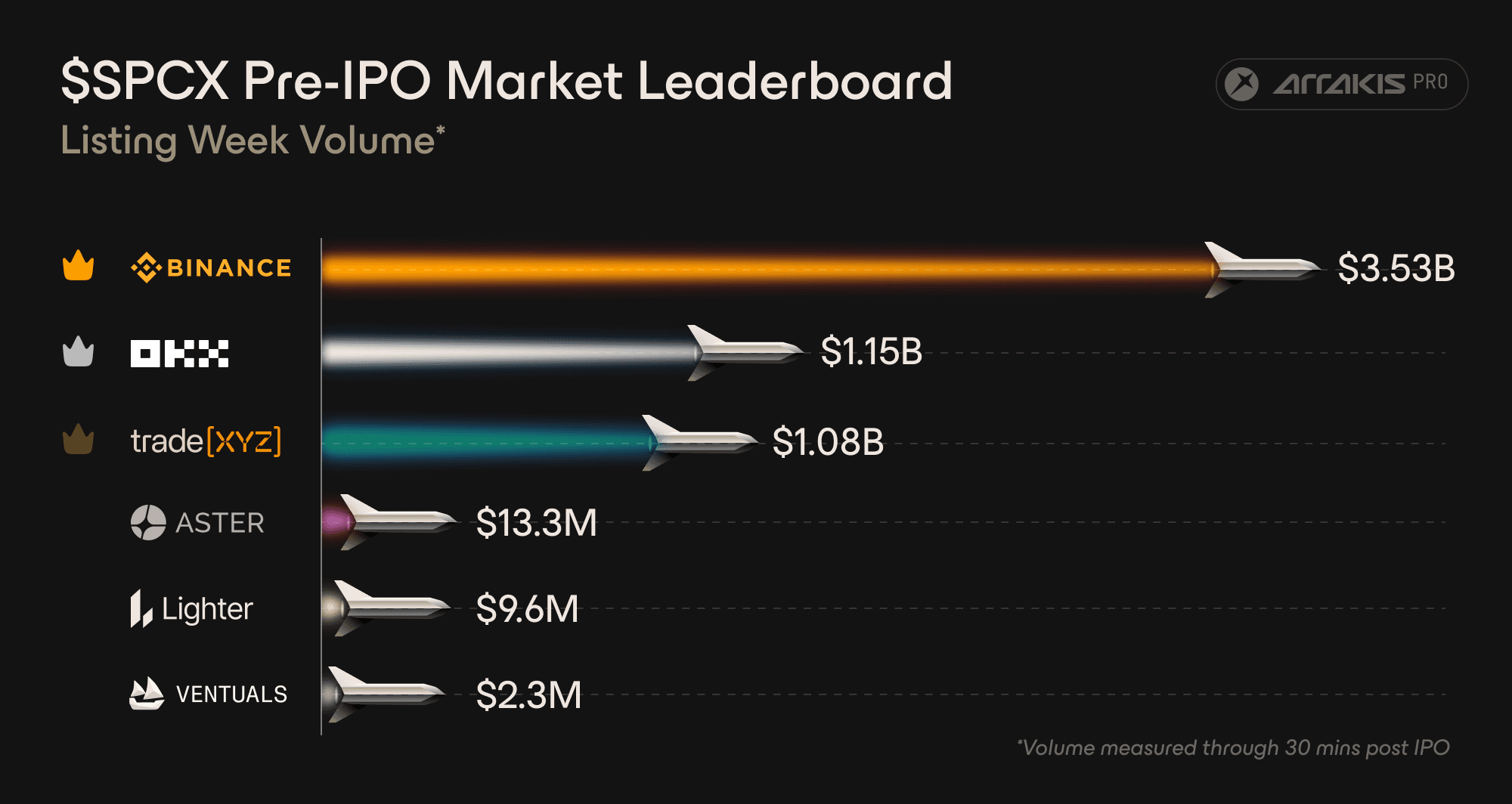
Listing day repeated the pattern at scale: in the first 30 minutes after the open the six venues turned over roughly $1.71B, with Binance taking $1.21B of it.
2.3 The Forecast
A pre-IPO market is a way to take synthetic exposure to where a stock will trade once it lists. The right test of such a market is accuracy: how close its price landed to what the stock actually opened at. We graded every venue at T_session, its time-weighted price over the final hour before the 13:30 UTC session open, against two targets, the Nasdaq opening print and the first-30-minute VWAP. The reading is taken an hour early on purpose. In the final minutes before an open, Nasdaq publishes auction indications and every book snaps onto them, so a mark taken at the open shows a market copying the answer rather than predicting it. SpaceX's opening cross did not print until 15:46 UTC, more than two hours after the 13:30 session open, so the 13:30 mark predates any same-day Nasdaq signal, including the pre-cross auction indications. SpaceX was the third conversion to take this test, and the two before it approached their prints from opposite sides:
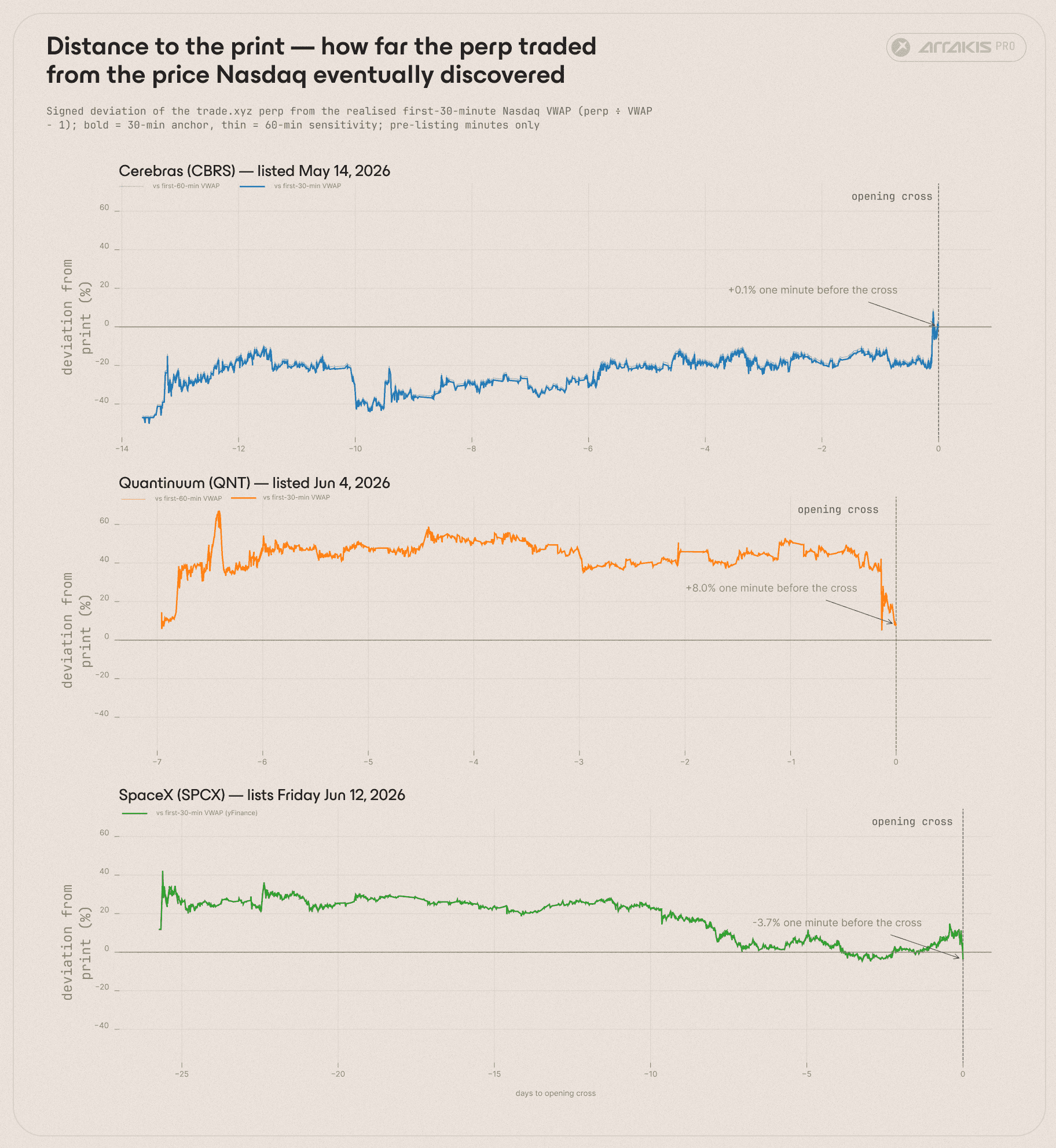
Each perp's mark against the first-30-minute Nasdaq VWAP it converted into. Cerebras lived below its eventual print, Quantinuum above, and both compressed into the open.
The venues themselves did not always agree on the price. In the first days of full capture the marks sat in two clusters, trade.xyz with OKX and Binance with Aster, at times 10% apart. The gap closed as the listing approached: by the morning of 12th June the four per-share venues were within 1.2% of one another, between $175.2 and $177.2, and the valuation-quoted venues sat roughly in line with them, Ventuals a touch cheaper and Lighter within the band (converted at the 13.08B prospectus count).
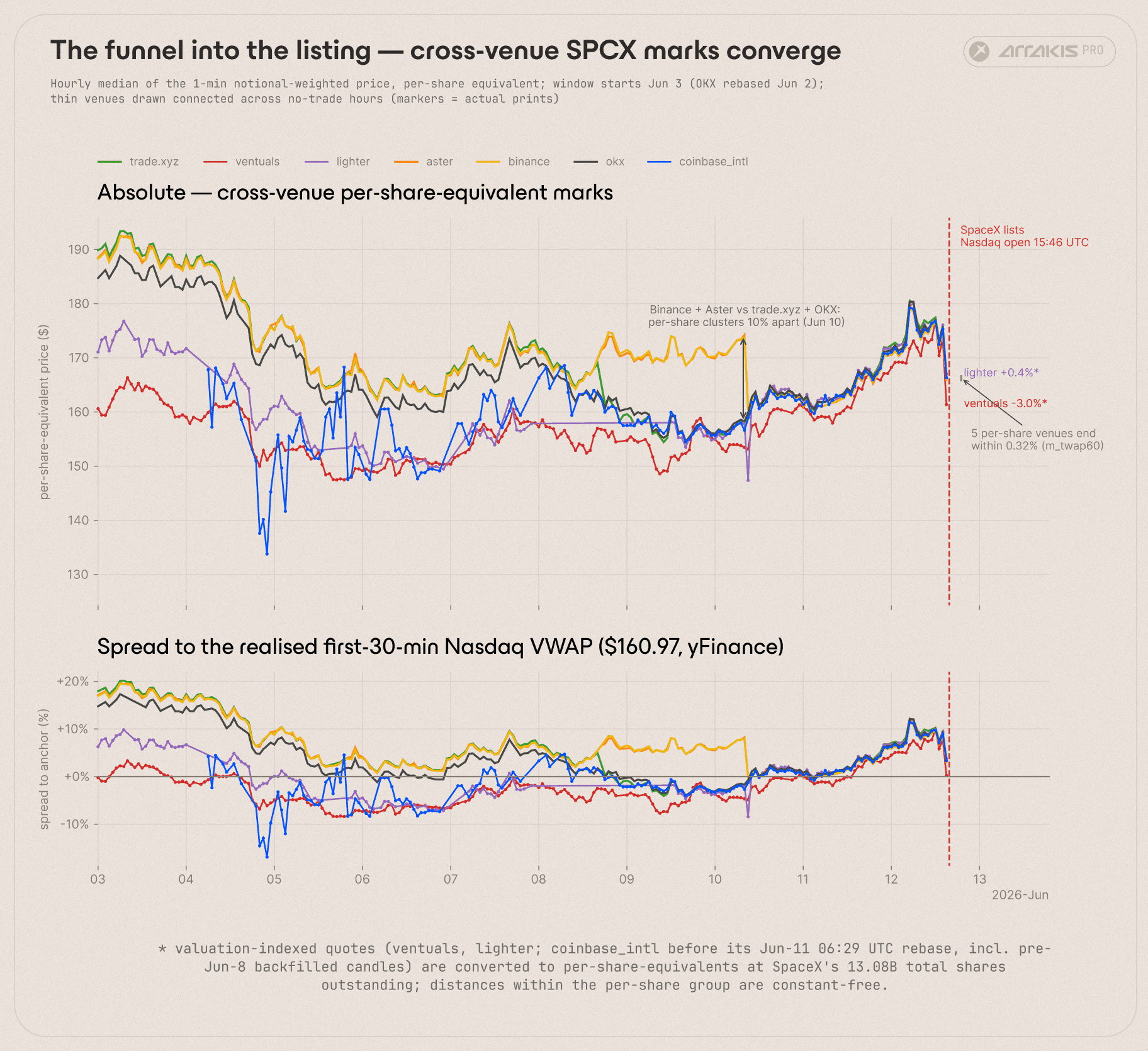
Top: cross-venue SPCX marks, per-share equivalent, funnelling into the listing. Bottom: each venue's mark as a percent spread to SpaceX's realised first-30-minute Nasdaq VWAP ($160.97). Valuation-quoted venues are converted at SpaceX's 13.08B shares outstanding.
The verdict was an overshoot. Every venue's final pre-listing mark, $173 to $177 per share, sat 15 to 18% above SpaceX's $150.00 open and 7.5 to 10% above its first-30-minute VWAP of $160.97; Ventuals was closest and trade.xyz widest. The perp had already started repricing down into the cross, and once the stock opened it rallied back up toward the perps, the two meeting near $160 to $163 within the first half hour. The market's standing mark ran high, but its direction was right and the gap closed fast.
3. How Pre-IPO Markets Have Evolved Over Past IPOs
Trade.xyz is the only venue that has carried all three pre-IPO perpetuals through conversion — Cerebras, Quantinuum, and SpaceX, all inside five weeks — so its book is where the asset class's evolution reads cleanest. Every number in this section is the trade.xyz market only, aligned by lifecycle age. Across the three launches, two trends ran on different axes: demand tracked the company, and market quality compounded with each launch.
Quantinuum came in smaller than Cerebras on every measure. SpaceX then traded $30.6M per day, eight to twelve times more than either predecessor.
Demand (trade.xyz) | CBRS (Cerebras) | QNT (Quantinuum) | SPCX (SpaceX) |
|---|---|---|---|
Launch to conversion | 1st May to 14th May | 28th May to 4th June | 17th May to 12th Jun |
Pre-listing volume | $47.9M | $18.4M | $794.3M |
Daily average (window) | $3.69M (13d) | $2.62M (7d) | $30.6M (26d) |
Conversion-day volume | $281.4M | $54.6M | $201.4M (first 30 min) |
Conversion-day ÷ pre-listing | 5.87× | 2.97× | pending (partial day) |
Pre-listing volume above counts every observed day to the open; §2.2's $728M is the same trade.xyz market over complete-capture days only.
The crowd got bigger and more top-heavy at the same time. SpaceX drew 17,882 unique wallets against Cerebras's 2,600 and Quantinuum's 1,690, yet the top-10 share and the Gini coefficient both rose.
Participation (trade.xyz) | CBRS (Cerebras) | QNT (Quantinuum) | SPCX (SpaceX) |
|---|---|---|---|
Unique wallets (pre-listing) | 2,600 | 1,690 | 17,882 |
Top-10 wallet share (taker vol.) | 15.5% | 19.7% | 25.9% |
Gini (taker vol.) | 0.840 | 0.820 | 0.946 |
Market quality is the trend that ran independent of the name. Volatility fell, the spread tightened, and the cost of moving $100k dropped by an order of magnitude across the three launches. Each market launched into a deeper book than the last:
Market quality (trade.xyz) | CBRS (Cerebras) | QNT (Quantinuum) | SPCX (SpaceX) |
|---|---|---|---|
Realised vol (annualised) | 282% | 190% | 60% |
Launch-phase median spread | 110 bps | 64 bps | 7.4 bps |
$100k slippage (launch phase) | 473 bps | 327 bps | 51 bps |
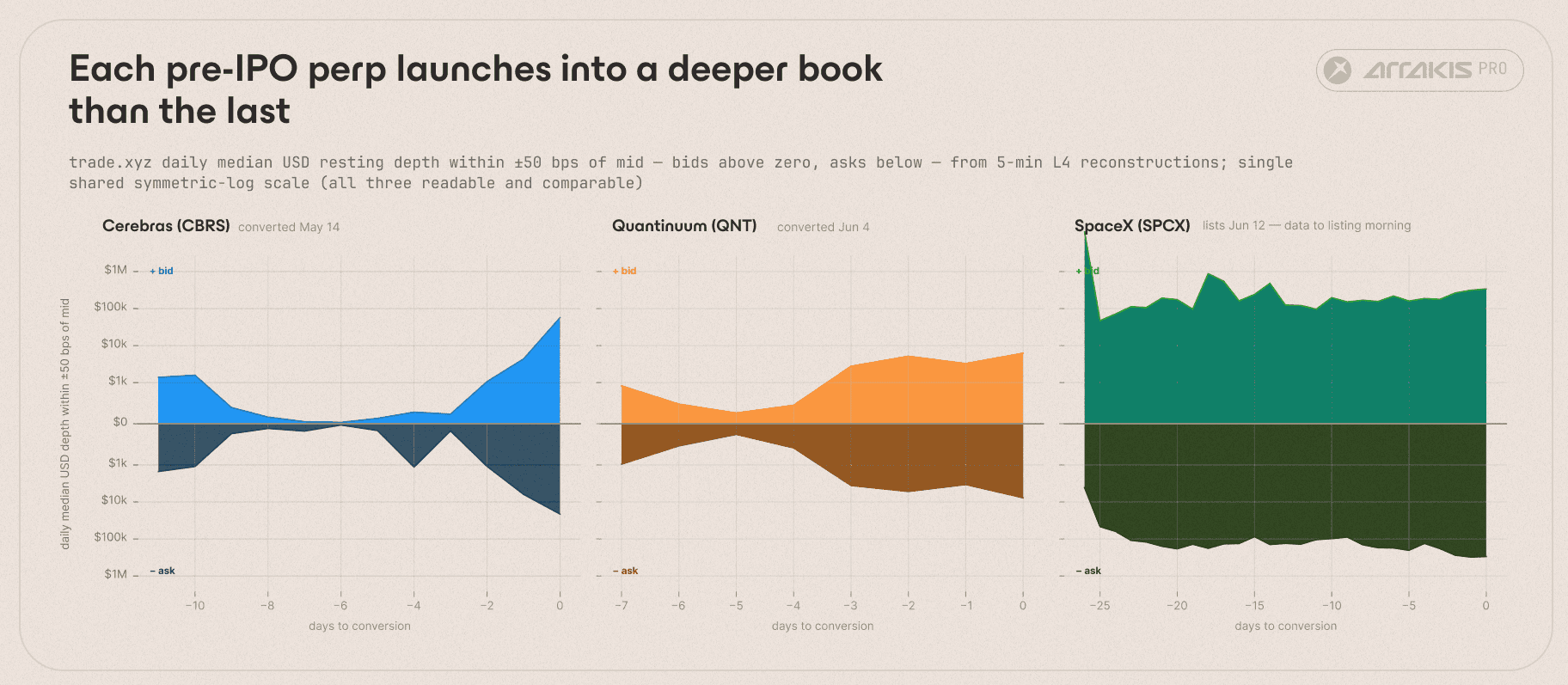
Resting order-book depth within ±50 bps of mid, bids above zero and asks below, by days to conversion.
For the two prior conversions the listing day out-traded the entire run-up, 5.87× for Cerebras and 2.97× for Quantinuum. SpaceX is on the same path: in the first 30 minutes after the open alone, trade.xyz turned over $201.4M, already more than triple Quantinuum's entire conversion day and 70% of Cerebras's, so with the day far from over its conversion volume is set to dwarf the $794.3M run-up as well; the full-day figure lands with the post-listing rerun. The run-up is the price-discovery event; the listing is the liquidity event. SpaceX is the third grade on that accuracy record: trade.xyz's final mark sat 18.1% above the $150 open, a miss to the high side alongside Cerebras's −18.5% and Quantinuum's +36.8%.
4. Pre-IPO Summer
SpaceX was the asset class's biggest test so far, and the one likely to bring it out of obscurity. A month ago, a pre-IPO perpetual meant one book per name. SpaceX changed that: a dozen venues quoting one pre-IPO company, more than $3B traded across the six we tracked by listing morning, and books that argued their way from 10% apart to a single implied price before Nasdaq printed one.
The queue behind it is the deepest set of private companies ever to approach the public market at once:
Company | Business | Reported valuation | Listing status (press, June 2026) |
|---|---|---|---|
OpenAI | AI models | ~$850B | No S-1 filed, late 2026 to 2027 window flagged by its CFO |
Anthropic | AI models | ~$900B in funding talks | IPO as early as October 2026 under active discussion |
Databricks | Data and AI platform | $134B last round, ~$165-175B in talks | S-1 expected around Q3 2026 |
Stripe | Payments | over $90B | IPO-ready by its own account, no rush |
Every name on that list will be priced continuously, across a dozen venues, from the day its listing rumour hardens. The template SpaceX just stress-tested is simple and every operator can read it: list the perp early, weaken the funding, let the crowd mark the price, convert at the open. Cerebras proved the mechanism and Quantinuum proved it repeats. SpaceX ran it at scale.
When the next rumour hardens, the things to watch are the ones we scored here: which venue lists first, where the depth forms, and how early the marks converge on one price. We will run the same scorecard on the first name off that list.
5. Methodology
Venues and data. We captured six order books continuously from 8th June at 100ms to 1s cadence (trade.xyz, Ventuals, Lighter, Aster, Binance, OKX). We backfilled trades to each venue's launch: REST backfills for Binance, Aster, and OKX, and Hyperliquid-family fills plus order-level (L4) books from a verified 0xArchive delivery (cutoff 9th June 12:00 UTC) with live capture after. The SpaceX Nasdaq reference is yFinance 1-minute bars: Databento's consolidated US-equities feed resolved the SPCX symbol but carried no trades on listing day, a day-one symbology gap. We recomputed every published number from raw fills and books in independent verification passes.
Windows. Depth and liquidity start 8th June, so book comparisons describe listing week. Volume and venue share run from each venue's launch, on complete capture days only. Longitudinal metrics align on lifecycle age, not calendar date.
Normalisation. The venues quote in two units: per-share (trade.xyz, Binance, Aster, OKX, ~$150 to 175) and company valuation in billions (Ventuals, Lighter, ~$1,950 to 2,175). We never compared raw prices across regimes. Valuation quotes convert to share-equivalents by dividing by SpaceX's shares outstanding, 13.08B. Before that count was public we calibrated it provisionally from the ratio of valuation-venue to per-share-venue medians, and Coinbase's own 11th June redenomination implied a divisor within about 1% of the 13.08B figure. OKX renamed and rebased its contract on 2nd June and Coinbase International switched SPCX-PERP from valuation to per-share quoting on 11th June, so we split both series at their seams and never charted a raw price across them.
Funding. trade.xyz ran pre-IPO funding at a 0.005 multiplier, 1% of its listed-equity standard. The other venues applied their own dampening. This is what lets the price float at the market's expected listing value instead of pinning to an oracle.
Metric definitions. T_session: time-weighted perp mark over the final hour before the 13:30 UTC session open. Accuracy targets: the Nasdaq opening print and the first-30-minute VWAP (yFinance 1-minute bars). Convergence: after the open, the gap between each venue's price and the Nasdaq tape. With only 1-minute Nasdaq bars we report it qualitatively (the post-open lock-on noted in §2.3) and deliberately do not fit a decay rate or half-life. Depth: L4 book reconstruction for Hyperliquid-family venues, validated tick-exact against an independent L2 feed, and native L2 for the centralised venues. We deduplicated Hyperliquid fills to one row per trade.
Caveats. The full venue list draws partly on Tier-2 web coverage, the six tracked venues are those with verifiable feeds. Three conversions is characterisation, not statistics. Book comparisons cover listing week only. Ventuals carries the oracle-glitch note below. Valuation-venue share-equivalents use SpaceX's 13.08B shares outstanding.