Case Study


Abstract
Aerodrome Ignition is the leading token launch mechanism on Base, combining distribution, price discovery, and liquidity bootstrapping in a single onchain framework. The flywheel it creates is designed to transition from incentive-driven to fee-driven sustainability as pools mature. Protocol-owned liquidity, actively managed from day one, accelerates that transition by concentrating capital where it generates the most trading fees.
What is Aerodrome Ignition?
Commanding over 51% of all DEX volume on Base in 2025, Aerodrome is the network's leading decentralised exchange. Ignition is its native token launch programme, designed to bootstrap onchain liquidity through Aerodrome's emissions flywheel. Projects deposit a portion of their token supply as incentives to attract veAERO voters, who direct AERO emissions towards the project's liquidity pool. These emissions draw LPs to deposit capital and deepen the market, building liquidity from the community rather than through traditional market-making arrangements.
How does it work?
Ignition utilises Aerodrome's emissions flywheel as part of the project's TGE strategy:
The issuer deposits a share of their token supply as voting incentives for a pool on Aerodrome.
veAERO holders vote for the pool to capture these incentives, directing AERO emissions towards it.
AERO emissions stream as liquidity rewards the following week, attracting LPs who deposit capital and deepen the market.
Deeper liquidity reduces slippage and improves execution, allowing the pool to capture higher onchain volume.
Higher volume generates more fee revenue, which attracts additional veAERO votes in subsequent epochs, compounding the cycle.
As the pool matures and fee revenue grows, the flywheel transitions from incentive-driven to fee-driven sustainability, where organic trading fees become attractive enough to sustain veAERO votes without continued incentive deposits.
What are its benefits?
Organic price discovery. veAERO voters allocate emissions based on opportunity cost, forgoing known rewards for a share of tokens with unknown value, and in doing so establish a voter-implied valuation before trading begins. Across all launches, week-one realized FDV exceeded voter-implied FDV by an average of 242%. In the strongest case, SYND achieved a 949% premium relative to its voter-implied valuation.
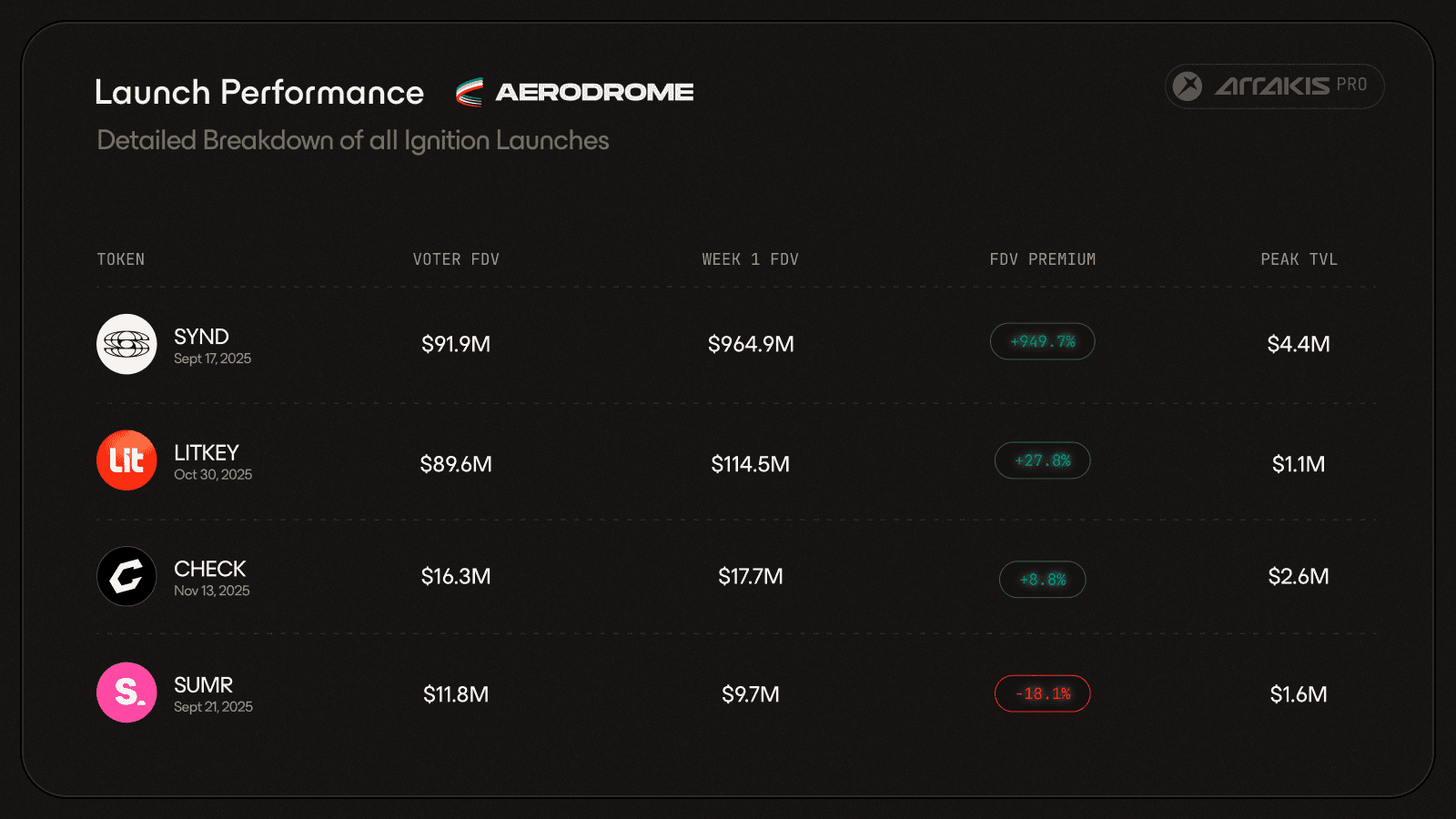
Voter-implied vs. week-one realised FDV across Ignition launches. Realised FDV exceeded voter-implied FDV in most cases, suggesting veAERO voters consistently price launches below where the market settles.
Distribution to CEXs. Every qualifying Ignition launch benefits from Coinbase's and OKX's DEX integrations. Projects gain instant access to CEX users without negotiating listing packages, surrendering unnecessary supply, or posting expensive capital guarantees. Distribution spans both onchain liquidity and two of the largest retail access points in crypto, at a fraction of the traditional listing cost.
Liquidity bootstrapping. Across past launches, Ignition pools have consistently bootstrapped productive liquidity within the first 24 hours, as LPs deposit capital to farm AERO emissions. This early concentration around the trading price is what enables organic trading from the start.
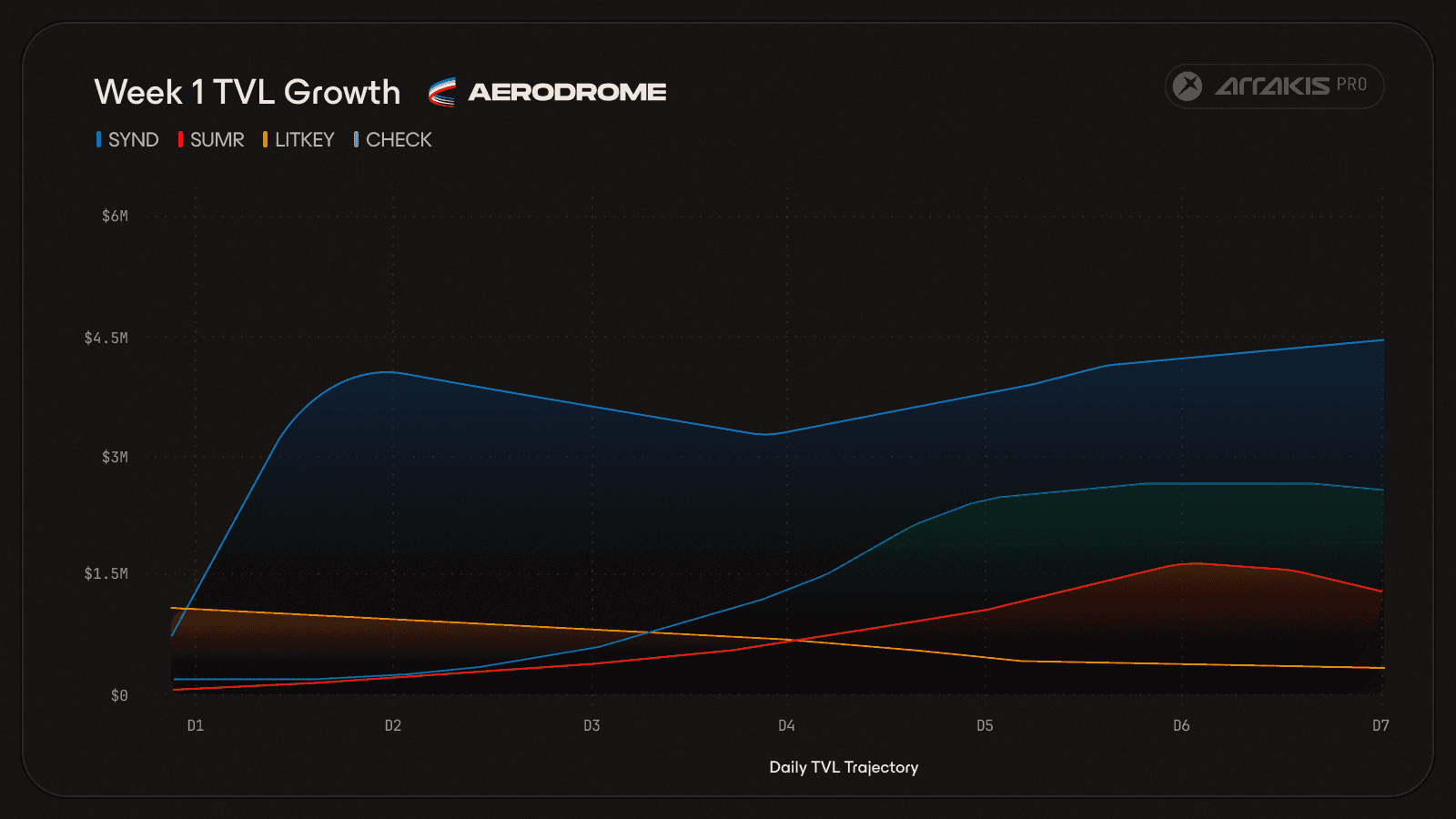
Week 1 TVL trajectory across Ignition launches. Most pools attracted meaningful liquidity within the first 24 hours, with TVL continuing to grow through the epoch as LP competition for AERO emissions intensified.
Full transparency. Every transaction, token flow, and vote allocation is recorded onchain. No backroom negotiations, hidden terms, or information asymmetry exists between insiders and the market.
The Transition: From Incentivised Liquidity to Fee Sustainability
Ignition solves the cold-start problem and gives projects a strong initial market. The path from that initial liquidity to a self-sustaining market, however, is one that every incentivised liquidity model in DeFi must navigate.
Incentive-driven LPs optimize for yield. They deposit capital, farm emissions, and rotate to the next highest-yielding opportunity when the epoch ends. This is how incentivized capital behaves across all of DeFi, from Curve wars to Uniswap liquidity mining programs to Aerodrome's emissions model. Ignition's flywheel is better engineered than most: as volume grows and fee revenue compounds, the pool becomes attractive to veAERO voters on its own merits, reducing the need for continued incentive deposits.
The question is how quickly a pool reaches that inflection point. Fee revenue per dollar of liquidity determines how fast the flywheel becomes self-sustaining. Full-range positions spread capital across the entire price curve, generating fewer fees relative to capital deployed. Concentrated positions generate more fees per dollar but require active management to stay in range.
This is where actively managed concentrated liquidity becomes important. Pools that generate higher fee revenue per dollar attract more veAERO votes organically, reducing the project's dependence on voting incentive budgets over time. The faster a pool reaches fee sustainability, the more durable the market Ignition built.
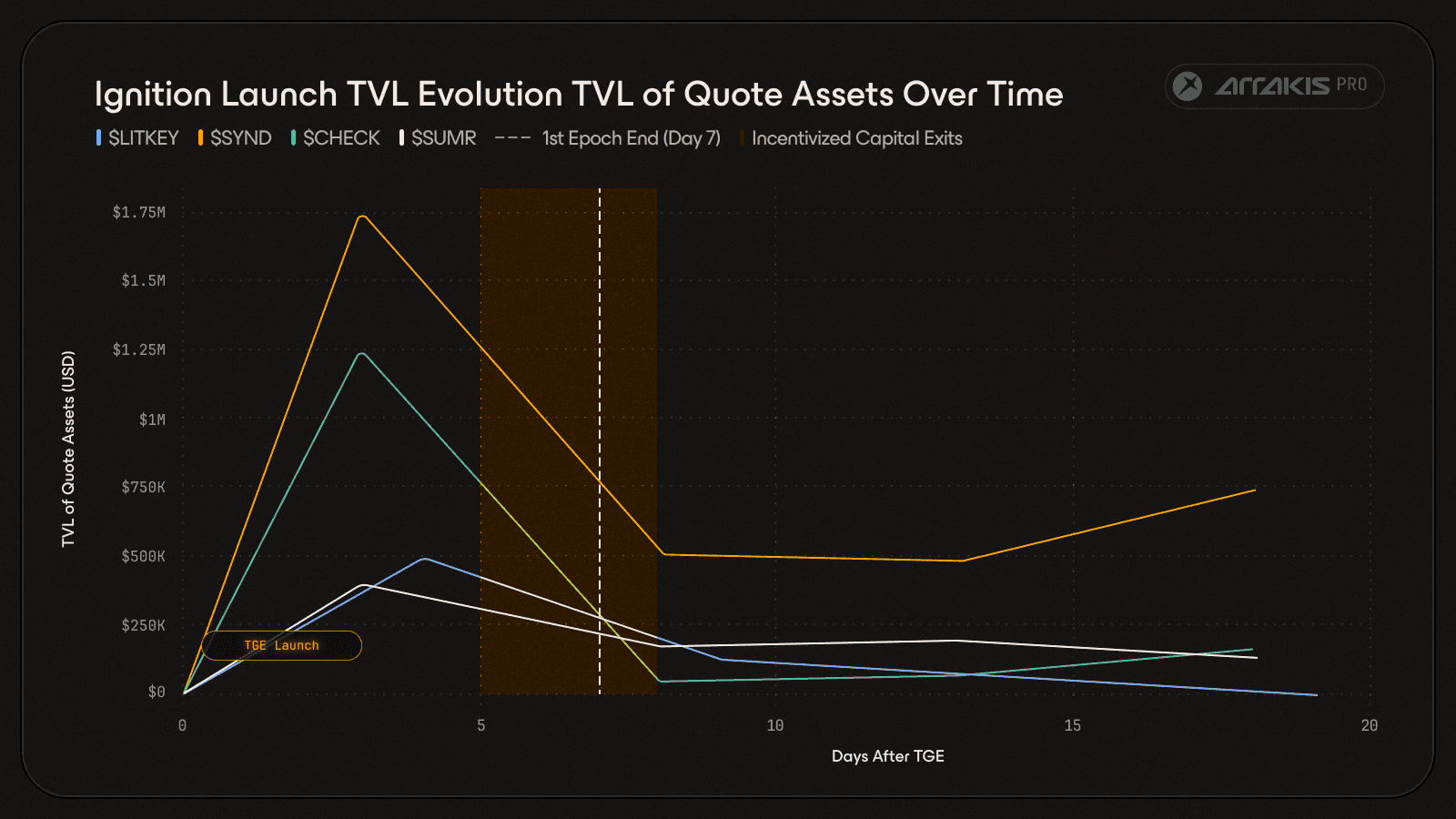
Quote-asset TVL indexed at different snapshots from TGEs across Ignition launches (TVL assumed 0 at TGE). Most pools see 50-95% liquidity withdrawal at epoch end as incentive-driven capital rotates, a pattern consistent with incentivised liquidity behaviour across DeFi.
Deepening Markets with Protocol-Owned Liquidity
Protocol-owned liquidity gives the project a permanent position that anchors the token's market through all conditions, complementing the liquidity that Ignition's emissions attract. Rather than relying solely on epoch-to-epoch incentive economics for depth, POL provides a base layer that remains deployed regardless of where yield-seeking capital rotates.
Ignition and Arrakis Pro solve different parts of the same problem. Ignition bootstraps the pool, handles price discovery, and activates the emissions flywheel. Arrakis Pro manages the pool's capital efficiency through both epochs, concentrating liquidity where it generates the most fees and accelerating the flywheel's path to organic sustainability.
POL in concentrated ranges accelerates the flywheel directly. Concentrated liquidity generates more trading fees per dollar deployed than full-range positions, because capital is focused where trades actually execute. More fees attract more veAERO votes organically, compounding the advantage that Ignition's initial bootstrapping created.
The way most projects have historically deployed POL is through full-range positions. This is the simplest approach, but the majority of capital sits far from the active trading price, contributing little to execution quality or depth where it matters. For $VSN, concentrated management through the Arrakis Aerodrome module delivered 4x greater depth per dollar deployed compared to a full-range position.
Projects that do deploy in concentrated ranges face a different challenge. Concentrated liquidity requires active management. Positions drift out of range as price moves, inventory becomes imbalanced, and depth at the trading price declines if positions are left static. For most teams, this operational overhead is unsustainable alongside everything else a launch demands.
Arrakis Pro manages this through a dedicated Aerodrome module. Ranges stay concentrated around the active trading price and adjust dynamically based on price movement, inventory, and volatility. Liquidity stays on Aerodrome, fully onchain and non-custodial. LP positions are auto-staked to receive AERO emissions, and the project maintains full control through an Arrakis private vault.
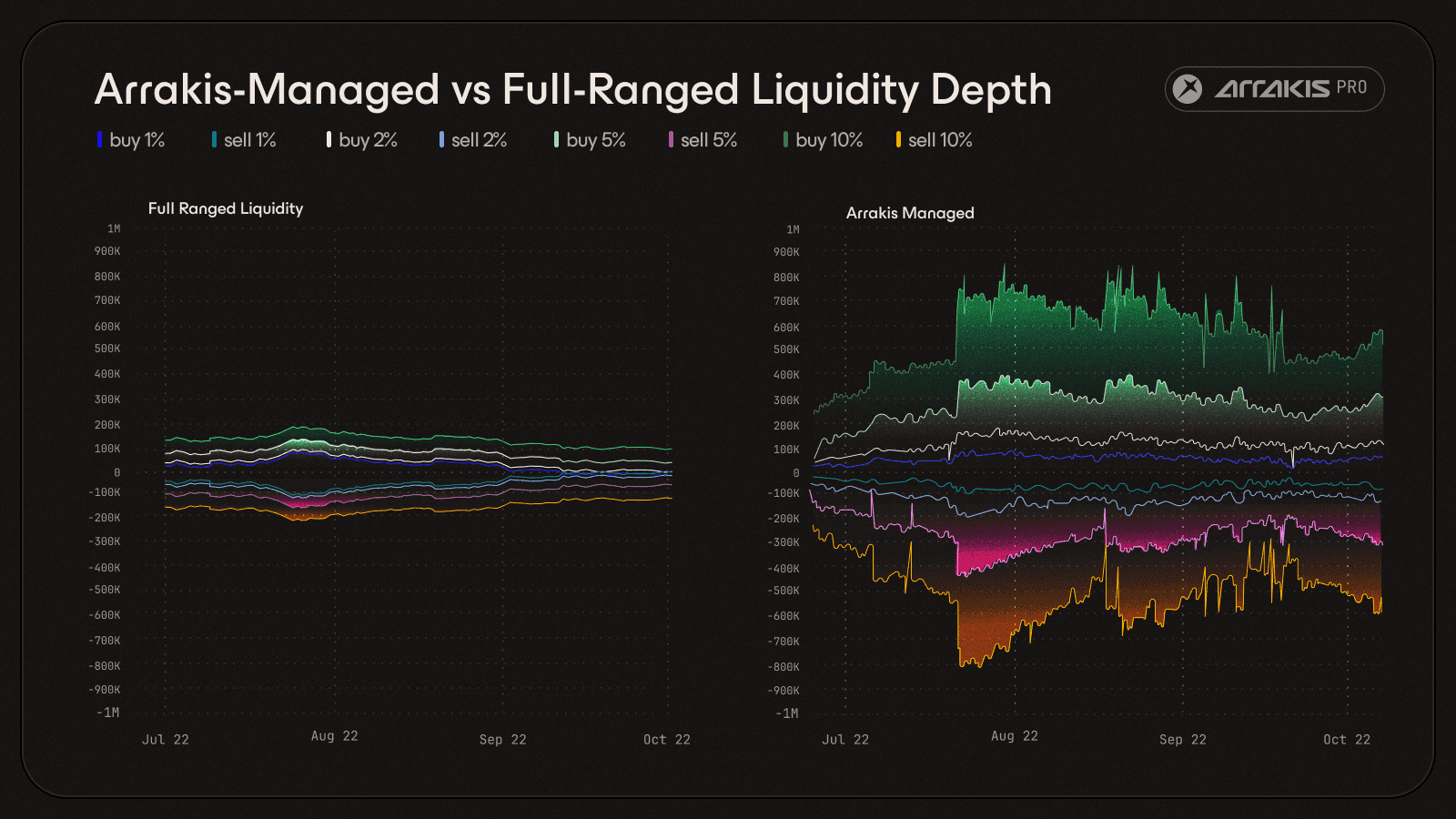
For $VSN, Arrakis' concentrated management (right) delivered up to 4× greater depth per dollar deployed versus full-range liquidity (left).
Week 1: Bootstrap Strategy
Most projects enter their TGE with a surplus of their own tokens but limited ETH or USDC. Building liquidity depth on a DEX requires quote-side capital that most treasuries lack at launch.
Arrakis' Bootstrap Strategy addresses this. Liquidity is deployed in asymmetric ranges weighted toward the project token, allowing natural price discovery while accumulating quote assets as buyers enter the pool. Ranges are rebalanced to continue capturing upside while building reserves, without introducing liquidity walls that distort the market. No large upfront treasury commitment is required.
By the end of the first epoch, the position progressively rebalances toward a healthier quote-side ratio, achieved through harvesting natural trading flow.
Week 2: Flagship Strategy
Once inventory is balanced, the Flagship Strategy takes over. Ranges are dynamically adjusted based on price, inventory, and volatility, concentrating in calm conditions to maximize capital efficiency and widening during sell-offs to manage exposure.
This is where protocol-owned liquidity proves its value. The Arrakis-managed position maintains concentrated depth at the trading price, ensuring the market remains deep as the LP base transitions from incentive-driven to fee-driven. The permanent POL base provides consistent execution quality, while Ignition's emissions continue to attract additional liquidity on top.
Ignition Only | Ignition + Arrakis Pro | |
Week 1 | Liquidity bootstrapped by AERO emissions. Quote-side inventory depends on market buying. | Quote assets accumulate as buyers enter. Inventory rebalances towards a healthy ratio through the Bootstrap strategy. |
Week 2 | Liquidity may fluctuate as incentive-driven LPs rebalance across pools. | Managed POL position maintains depth through LP rotation cycles. |
Week 3+ | Ongoing voting incentives may be needed to maintain target depth while the pool builds toward fee sustainability. | POL provides a durable base layer. Emissions compound on a stronger liquidity foundation, accelerating the path to organic sustainability. |
Final Note
Aerodrome Ignition addresses the most difficult parts of a token launch: price discovery, distribution, and bootstrapping initial liquidity. The flywheel it creates transitions from incentive-driven to fee-driven sustainability over time.
Protocol-owned liquidity, actively managed with Arrakis Pro, accelerates that transition by keeping liquidity concentrated at the trading price, generating more fees per dollar deployed, and ensuring depth remains consistent as the LP base evolves.
Teams planning an Ignition launch should treat liquidity management as part of the launch planning itself, not something to figure out after the first epoch.
Fill out our contact form to start planning your Ignition launch with Arrakis.